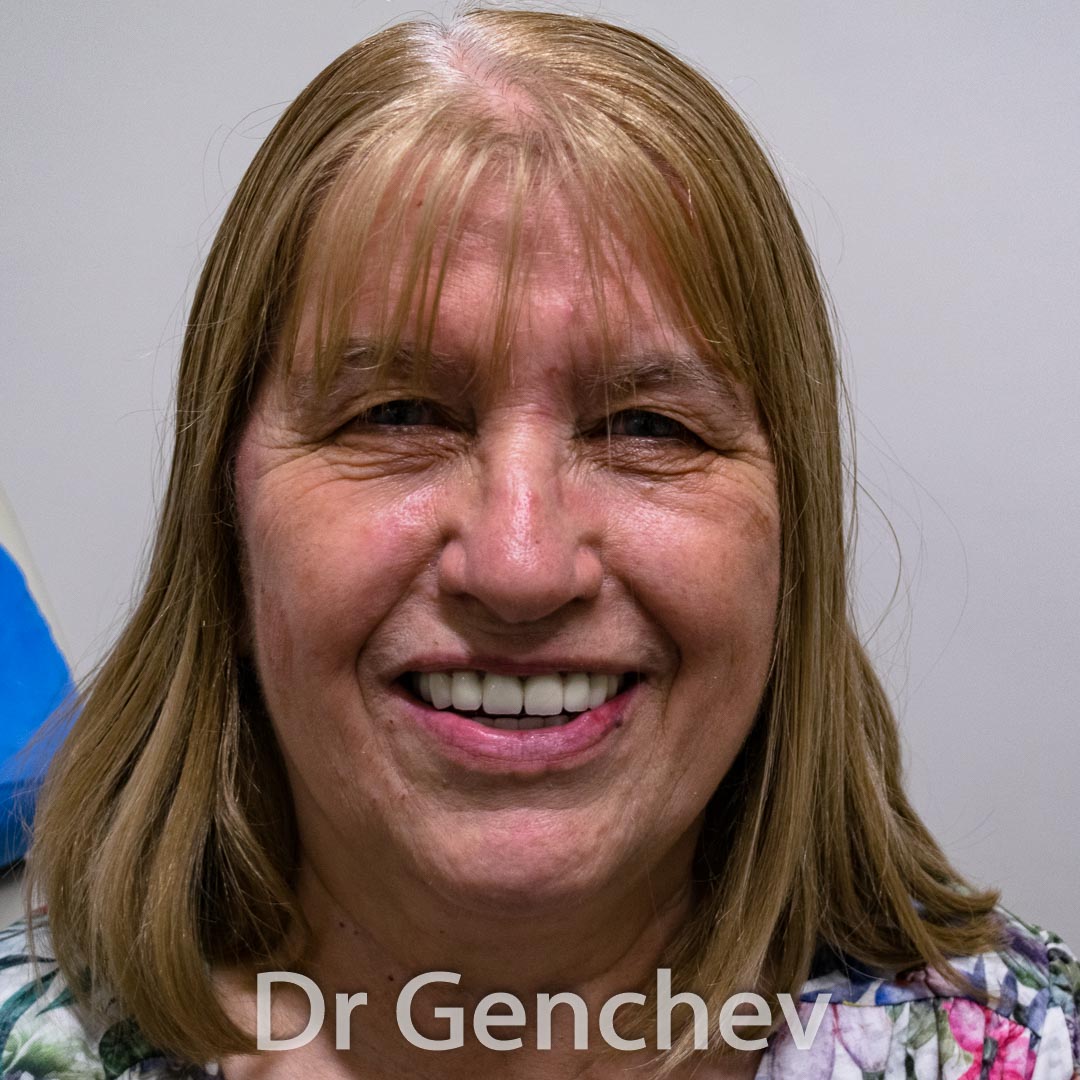
How Dr Genchev restored Veronique’s smile after advanced gum disease with basal implants?
Dr. Genchev transformed Véronique’s life in just 5 days with basal implants, restoring her ability to eat without pain and giving her back a confident smile. Véronique suffered from advanced periodontal disease that left her with multiple missing teeth, loose front teeth, and painful inflammation that made eating difficult. Her story demonstrates how basal dental implants can transform the lives of patients suffering from severe gum disease and bone loss. As a French patient facing treatment costs of €40,000 at home, she traveled to Bulgaria and received complete dental restoration of both jaws for €9,990, a savings of €30,000 while avoiding months of bone grafting procedures.
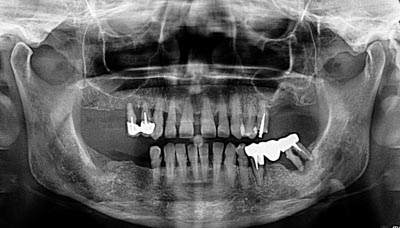
Clinical Diagnosis: The patient presented with Advanced Chronic Periodontitis (classified under ICD-10: K05.3), characterized by systemic tooth mobility and significant alveolar bone loss.
Why Basal Dental Implants
What makes basal implants the best solution for advanced gum disease?
Véronique’s dental situation was deteriorating rapidly due to advanced periodontal disease. The inflammation and infection in her gums had caused significant bone loss throughout both jaws, leaving her with missing teeth at the back and loose teeth in the front. Her remaining teeth were becoming increasingly unstable as the soft cancellous bone that holds tooth roots continued to resorb. The pain and difficulty eating were affecting her quality of life every single day.
Conventional implant dentists in France told Véronique she would need extensive bone grafting procedures to rebuild the missing bone before any implants could be placed. This would have required multiple surgeries spread over 12-18 months, with healing time between each procedure. The bone grafts themselves carry a 20-30% failure rate in patients with advanced gum disease like Véronique’s, meaning she might have endured months of treatment and spent €40,000 only to face complications and potential failure.
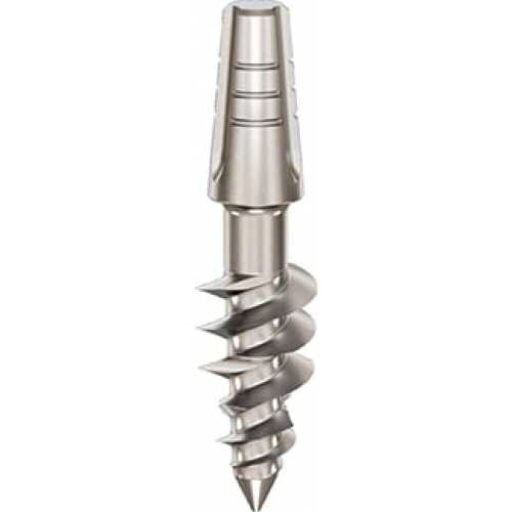
Basal implants offered a superior solution because they are longer than conventional implants and anchor directly into the hard cortical bone of the jaw. This deeper bone layer remains stable even when the soft cancellous bone has resorbed due to gum disease. By utilizing the cortical bone, basal implants avoid the need for bone grafting entirely, eliminating months of healing time, the substantial costs associated with grafting procedures, and the risk of graft failure that is particularly high in periodontitis patients.
Véronique’s Severe Periodontitis
What were the specific problems caused by her gum disease?
Advanced periodontal disease had severely compromised both of Véronique’s jaws, creating multiple challenges that required comprehensive treatment.

Dr Genchev
basal Implant Dentist
Dr Georgy Genchev treats the most complex patients that have no teeth and total bone loss.
His patients come from the USA, Canada, France, Belgium and Switzerland because he treats the patients that other dentists cannot help.
Upper Jaw Dental Condition
Véronique’s upper jaw showed classic signs of advanced gum disease with widespread damage. She was missing two molars and one premolar at the back of her mouth on both sides, leaving large gaps that made chewing difficult and uncomfortable. Her gums had receded significantly, exposing tooth roots and creating sensitivity. The front teeth had become loose due to bone loss around their roots, a dangerous progression that would eventually lead to these teeth falling out if left untreated.
Three of her upper teeth had been devitalized (had root canal treatment previously), including teeth 14, 15, and 25. Tooth 14 had developed a granuloma at the root, which is a pocket of infection that forms when bacteria invade the bone around a dead tooth. This infection was spreading into the surrounding bone tissue, accelerating bone loss and putting adjacent teeth at risk. The combination of missing back teeth, loose front teeth, receding gums, and infection created a complex situation requiring immediate comprehensive treatment.
Lower Jaw Dental Condition
The lower jaw presented equally serious challenges from the periodontal disease. Véronique was missing three teeth on the right side (teeth 45, 46, 47), creating a large gap that forced her to chew only on the left side of her mouth. This uneven chewing pattern was accelerating wear on her remaining teeth and putting excessive stress on her jaw joint.
She had an old bridge consisting of three crowns supported by just two tooth roots (teeth 35 and 37). This bridge had become loose because the supporting tooth roots had lost so much bone that they were barely anchored in the jaw. The roots were literally protruding out of the bone. Gum resorption around her central lower teeth was progressing, threatening these teeth as well. The failing bridge and missing teeth on the right side meant Véronique could barely chew fibrous foods and had to restrict her diet to soft foods that didn’t require much mastication.
Dr. Genchev’s Treatment Plan
What was the treatment for Véronique's case?
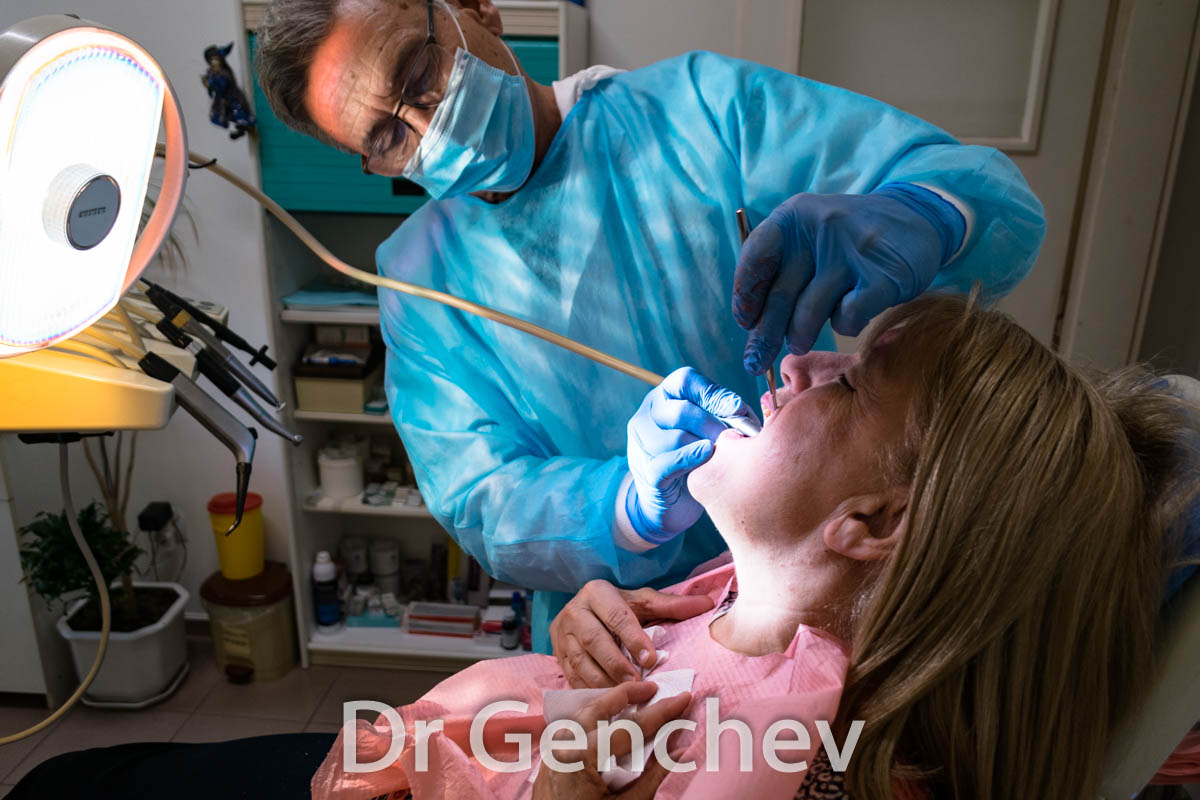
Dr. Genchev designed a comprehensive treatment plan to restore Véronique’s complete smile in just 5 days. The accelerated timeline was possible because basal implants can be loaded immediately with a dental bridge, unlike conventional implants that require 3-6 months of healing before attaching the final teeth.
Tooth Extractions and Infection Cleaning
The first critical step involved removing teeth that were too compromised to save and cleaning all infection sites. Dr. Genchev extracted teeth 14 and 15 from the upper jaw, these were the devitalized teeth that were no longer viable. Tooth 14 had the granuloma infection at its root, which required thorough cleaning and curettage to remove all infected tissue from the bone. This deep cleaning prevents the infection from spreading and compromises the success of the new implants.
In the lower jaw, Dr. Genchev extracted teeth 35 and 37, which were the failing roots supporting the loose bridge. These teeth had lost so much bone support that keeping them would have compromised the stability of the entire restoration. Removing compromised teeth and thoroughly cleaning infection sites creates a healthy foundation for the basal implants to integrate successfully with the bone.
- Dentist : Dr Genchev
- Patient : Gum disease
- Treatment : Full mouth dental implant
- Dental Implant : Basal Implant IhdeDental
- Location : Plovdiv Bulgaria
- Time : 1 visit 5 days
- Price : €9990 Euro
Upper Jaw Implantation
On the upper jaw, Véronique had soft cancellous bone, the dense cortical bone structure, qualified as bone type D3 (Thin porous cortical bone | SNOMED CT 274191005) and D4 (Fine trabecular bone | SNOMED CT 51381005), that was not good quality for implantation.
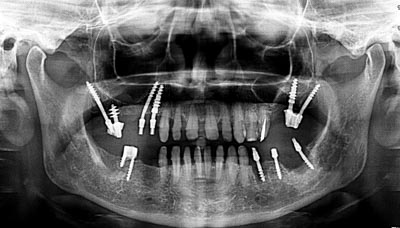
At the back of the upper jaw in position 17 and 27, he placed on each side one tubero-pterygoid implant. He chose Ihde Dental BCS. They were anchored into the pterygoid process of sphenoid bone (Classification: SNOMED CT 72891007) of the sphenoid bone to provide maximum stability.
And in position 16 and 26 he placed 🇨🇭 Ihde Dental TPG Uno implants that were anchored to the pyramidal process of the palatine bone (Classification: SNOMED CT 84154003).
And in the frontal area in position 14 and 15 he placed two implants Ihde Dental BCS and Ihde Dental TPG Uno that were anchored into the nasal cortex.
In total, Dr. Genchev placed 7 basal dental implants in Véronique’s upper jaw to create a stable foundation for her new teeth. The strategic placement ensured even distribution of chewing forces and full restoration of functionality. He positioned two basal implants in zones 14 and 15 where the infected teeth had been extracted, replacing the missing teeth and restoring support in this critical area.
The most important innovation for Véronique’s case was the placement of four tubero-pterygoid implants, two on each side positioned behind the sinuses. These specialized longer basal implants anchor in the pterygoid bone at the very back of the upper jaw, recreating the molar teeth that are essential for normal chewing. Unlike conventional implants that would require sinus lift procedures to place implants in this area, pterygoid implants bypass the sinuses entirely, eliminating the risk of sinus complications and chronic sinusitis.
Lower Jaw Implantation
In the lower jaw, Dr. Genchev placed 4 basal implants to replace the missing teeth and failing bridge. Dr Genchev selected Ihde Dental BCS to use the cortical bone in order to achieve good stability for the dental bridge. He placed in position 37 and 26, Ihde Dental BCS that were anchored into the Mylohyoid line.
Three implants were positioned in zones 35 to 37 on the left side where the loose bridge had been, and two more implants were placed in zones 46 and 47 on the right side where teeth had been missing. This distribution of implants along the full length of the lower jaw ensures that Véronique can chew evenly on both sides of her mouth with her back molar teeth.
The total of 11 basal implants (7 upper, 4 lower) provides exceptional stability and recreates the natural functionality of Véronique’s mouth. This is significantly more support than the conventional All-on-4 system that uses only 4 implants per jaw and often leaves the back areas unsupported.
Ihde Dental Dental implants
Dr. Genchev selected Ihde Dental brand basal implants for Véronique’s treatment, using the types KOS ROOT, BCS and TPG Uno.
The New Teeth
What did Véronique's final teeth look like?
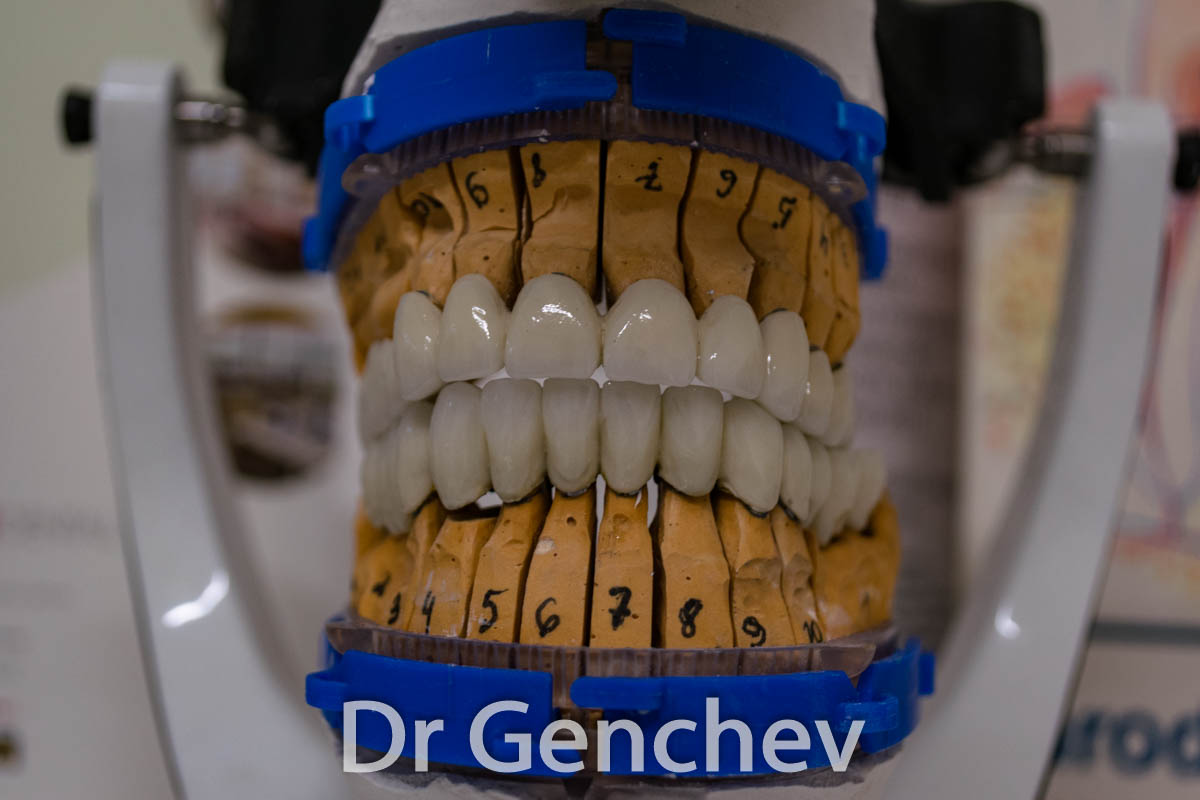
The prosthetist of Dr. Genchev created two complete dental bridges for Véronique, one for the upper jaw and one for the lower jaw. Each bridge consists of 14 connected dental crowns that fit precisely over the basal implants and any preserved healthy teeth. These made-to-measure bridges were custom-designed specifically for Véronique’s facial structure, bite alignment, and aesthetic preferences.
PFM Dental Crowns
Véronique chose PFM (porcelain-fused-to-metal) metal-ceramic bridges, which offer the best balance of strength, durability, and natural appearance at a moderate price point. PFM crowns feature a strong metal base made from chrome-cobalt alloy, covered with a ceramic overlay that looks like natural tooth enamel. The metal base provides exceptional durability to withstand strong chewing forces, important for someone like Véronique who wants to return to eating normal foods.
Aesthetic Choices
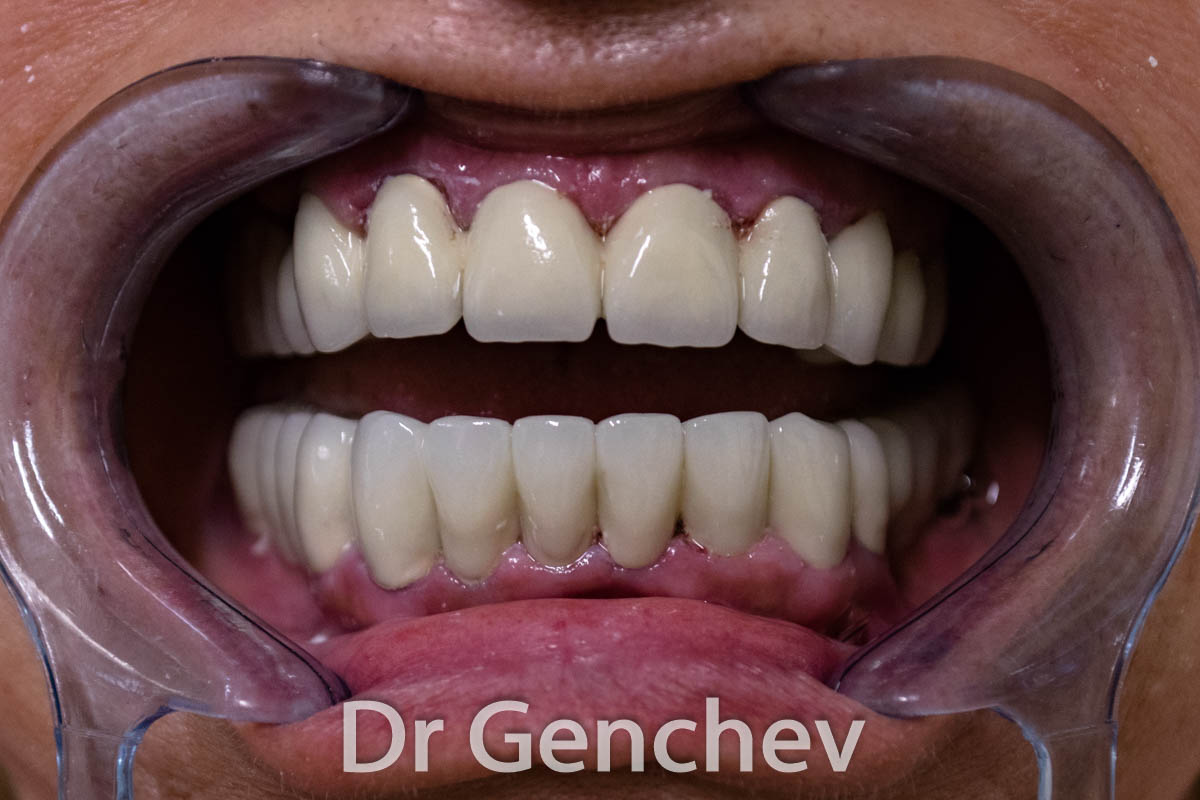
Véronique selected shade A2 for her new teeth, which is the most popular natural off-white color. A2 matches the color of healthy adult teeth and looks completely natural and age-appropriate while still being bright and clean. This shade blends beautifully with facial features and doesn’t draw attention to itself, people see a beautiful natural smile rather than obviously artificial teeth.
She also chose rounded-shaped teeth, which create a softer, more youthful appearance. Rounded tooth edges give a gentle, approachable look that many patients prefer. The combination of A2 shade and rounded shape gives Véronique a smile that looks natural, healthy, and completely her own.
Dr. Genchev in Plovdiv Bulgaria
What qualifications and experience should I look for in a basal implant dentist?
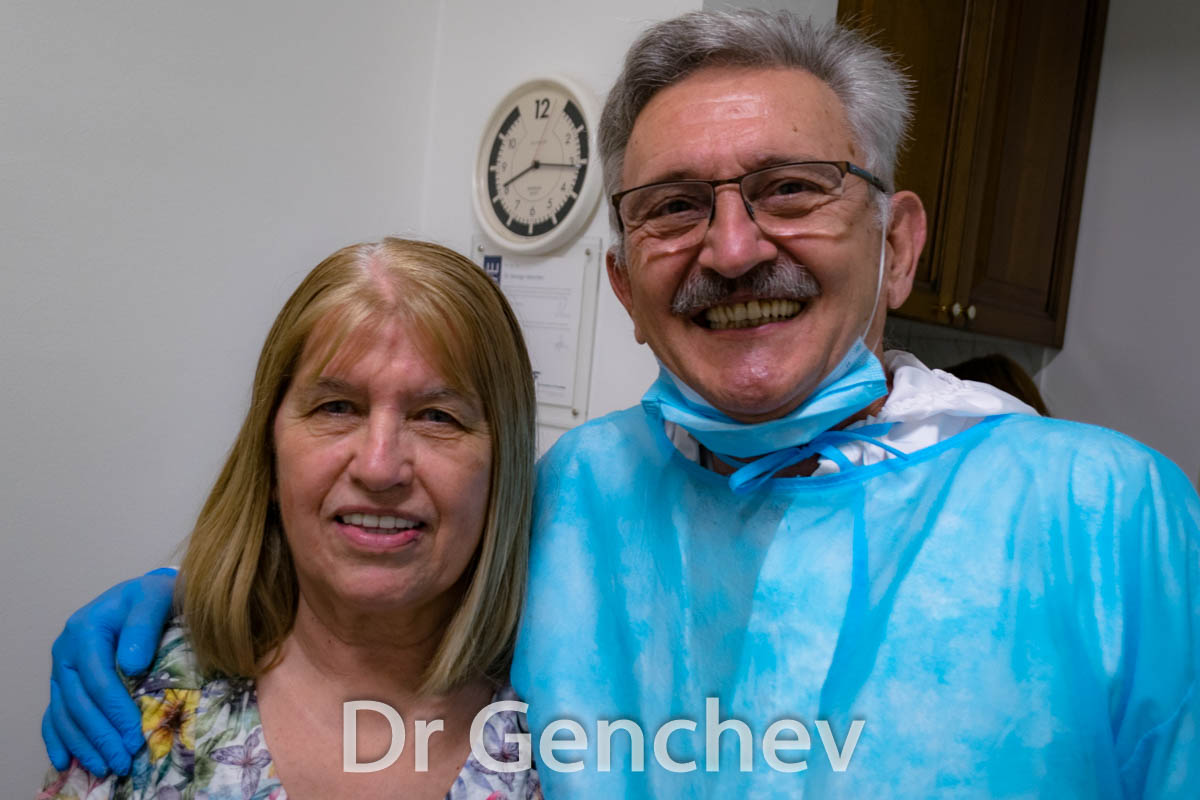
Dr. Genchev brings exceptional experience to his basal implant practice in Plovdiv, Bulgaria. With 40 years as a dentist, he represents one of the most experienced practitioners in Europe. His journey into basal implantology began after 15 years of practicing conventional implantology, giving him a comprehensive understanding of both approaches and why basal implants deliver superior results for complex cases.
For the past 12 years, Dr. Genchev has specialized exclusively in basal implantology, performing hundreds of full mouth reconstructions for patients with advanced gum disease, severe bone loss, and complex dental conditions.
His practice in Plovdiv serves patients from across Europe, particularly from France, Germany, the UK, and other Western European countries where basal implantology is either not available or prohibitively expensive. Dr. Genchev’s treatment cost of €9,990 for complete restoration of both jaws represents exceptional value, especially when compared to the €40,000 that the same treatment would cost in France.
Medical Disclaimer & Review
This article was produced by The Dentist Marketing Agency for educational purposes and was medically reviewed by Dr. Genchev on August 16, 2026, to ensure clinical accuracy. Dr. Genchev specializes in the full dental restoration protocol, which utilizes basal implants to rehabilitate edentulous patients with severe gum disease without the need for bone grafting. Dr. Genchev ensures that all descriptions of the implantation technique, the €9,990 pricing for both jaws and the single visit of 5 days treatment timeline reflects current clinical practice and safety standards.
Last Updated: 08-16-2026
How to book a consultation?
Ask for a call back from Dr Genchev
Ask Dr Genchev for a consultation for a dental restoration with basal dental implants. Dr Genchev will explain the treatment plan based on your dental condition and provide a price for the treatment.
Request a call
Treatment Overview
Dental restoration with basal dental implants:
- Treatment: Rehabilitation of 1 or 2 jaws.
- Dental condition: Dr Genchev treats gum disease, bone loss, and total edntulism.
- Price: Depending on the treatment.
- Location: Plovdiv, Bulgaria.
- Time: 5 days.
By completing the enquiry form you agree to Dr Genchev’s team contacting you. The Basal Dental Implant Association does not endorse any dentist featured on its website. And it is not responsible for your choice of dentist and dental treatment.