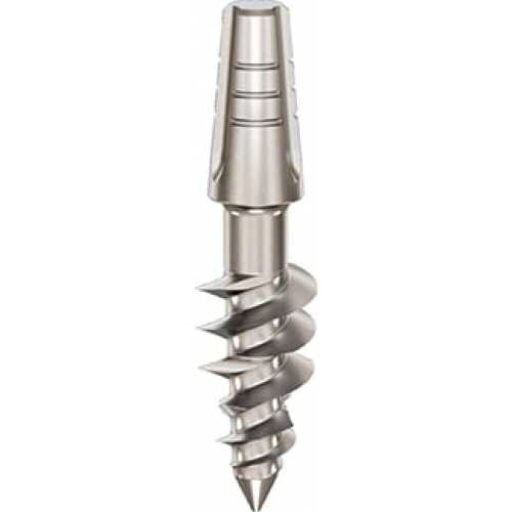
How basal implants successfully fully restored teeth after multiple failed bone grafts?
Dr. Genchev transformed Paul’s life in just 5 days with basal implants after three conventional implant attempts had failed catastrophically. Paul, a French patient suffering from total edentulism and severe bone atrophy in his upper jaw, had endured three failed bone grafting procedures in Turkey, Hungary, and France. Each time, surgeons opened his jaw and placed bone graft material that never hardened, remaining as gel-like powder that provided no foundation for implants. Metal pins from the bone graft mesh were still visible in his X-rays, testament to the failed procedures. No implant dentist in France 🇫🇷 would accept his case, condemning him to an unstable denture. His story demonstrates how basal dental implants can succeed in seemingly hopeless cases where conventional implantology has repeatedly failed. For just €6,500, Paul received complete upper jaw restoration with 18 basal implants, a savings of €18,500 compared to France’s €25,000 cost for the same treatment.
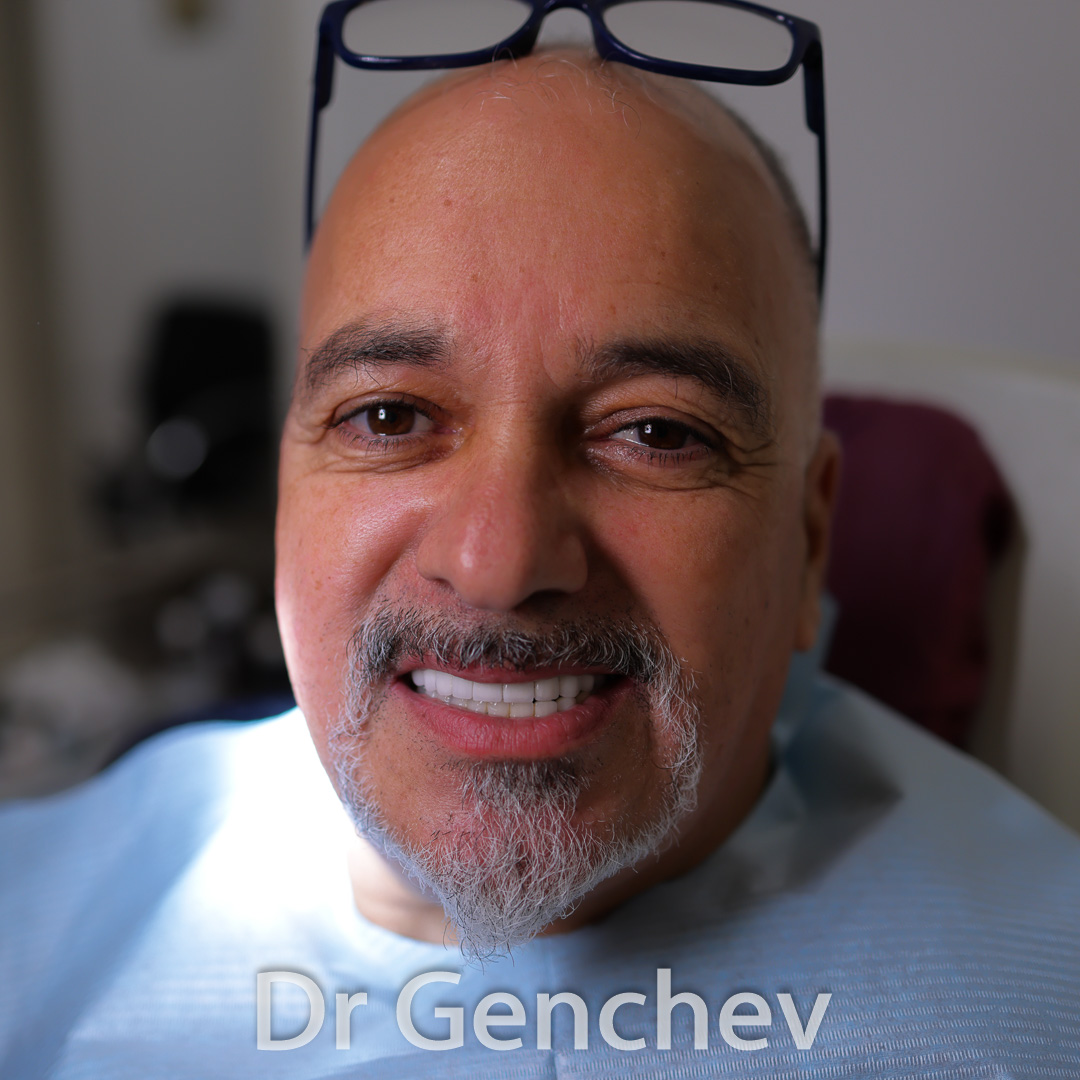
Basal Implants After Conventional Implants
What makes basal implants effective when bone grafting has failed repeatedly?
Paul’s dental situation represented one of the most challenging cases in implant dentistry. He had lost all his upper teeth and suffered from severe bone atrophy with extremely poor, porous bone quality. The soft cancellous bone that conventional implants depend on had completely resorbed, leaving insufficient foundation for traditional implant placement.
Over several years, Paul sought treatment at three different clinics, desperately hoping to restore his teeth. In Turkey, Budapest, and France, conventional implant dentists told him the same thing: he needed bone grafting before any implants could be placed. Each clinic performed bone graft procedures, opening his upper jaw surgically and filling the deficient areas with bone powder material. Each time, Paul endured the surgery, the pain, the healing period, and the hope that this time would be different.
Watch the video of this case study for Paul who suffered from severe bone atrophy
and was successfully treated with basal implants
But each bone graft failed. The powder material never hardened into solid bone as it should. Instead, it remained as a gel-like substance that provided no structural support whatsoever. The metal pins and mesh used to hold the graft material in place were still visible in Paul’s panoramic X-rays, evidence of three failed attempts to rebuild his bone. After the third failure, no implant dentist in France would accept his case. They considered him too high-risk, with bone quality too poor to support conventional implants even with grafting.
Paul faced the prospect of wearing an unstable denture for the rest of his life. Dentures without sufficient bone support slip constantly, make eating difficult, and continue to accelerate bone loss. The psychological impact of losing all hope for fixed teeth was devastating. Then Paul discovered basal implants and Dr. Genchev’s expertise in treating seemingly hopeless cases.
Basal implants offered the solution Paul desperately needed because they function on completely different principles than conventional implants. Instead of depending on the soft cancellous bone that had failed to regenerate through grafting, basal implants are longer and anchor directly into the hard cortical bone deeper in the jaw. This cortical bone layer remains stable even when the cancellous bone has completely resorbed. It doesn’t require grafting or augmentation, it simply needs to be accessed with longer implants.
Basal Implants For Severe Bone Atrophy
What specific problems did Paul's bone loss create?
Paul’s upper jaw presented extreme challenges that explained why conventional implantology had failed him repeatedly. Total edentulism meant he had no natural teeth remaining, they had all been lost over time due to the progressive bone atrophy. The X-rays revealed severe bone loss throughout the entire upper jaw, with the bone height significantly reduced from normal levels.
Most critically, Paul’s bone quality was exceptionally poor and porous. Even where some bone volume remained, the structure was weak and spongy. The powder of the bio-bone material never hardened. As a result, no solid foundation for the dental implants ever developed.
The metal pins from the bone graft mesh were still embedded in his jaw, visible on the panoramic X-rays as small white dots scattered throughout the upper jaw. These pins were intended to hold the mesh that contained the bone graft powder in place while it hardened. But when the graft failed, the pins remained as foreign objects in his jaw, a constant reminder of the failed procedures.
This combination of total tooth loss, severe bone atrophy, and extremely poor bone quality made Paul’s case one that conventional implant dentists considered impossible. The soft cancellous bone they rely on simply didn’t exist in sufficient quality or quantity. No amount of bone grafting could create the foundation needed because Paul’s bone cells couldn’t convert the graft material into solid bone.
Strategic Basal Implantation
How did Dr. Genchev plan to restore Paul's teeth when others had failed?
Dr. Genchev evaluated Paul’s case and immediately recognized that conventional approaches had failed because they were fundamentally flawed for his condition. Instead, Dr. Genchev designed a treatment plan that used longer basal implants that could reach and anchor into the hard cortical bone that is deeper.
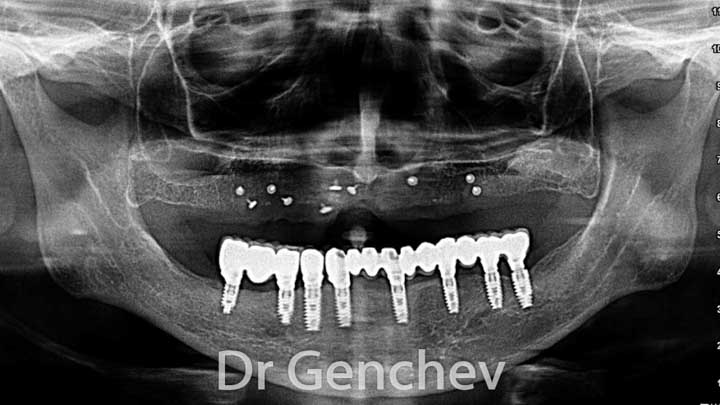
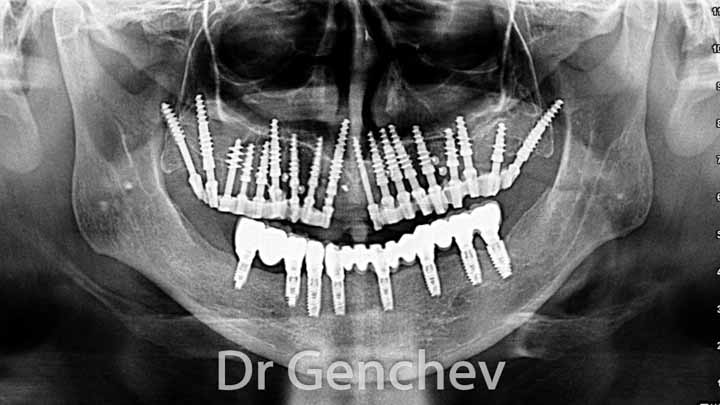
Upper Jaw 18 Basal Implants
Why did Paul need 18 implants when conventional systems use only 4-6?
Dr. Genchev’s treatment plan for Paul’s upper jaw was comprehensive and strategic. He placed a total of 18 basal implants, an exceptionally high number that was necessary because of Paul’s poor bone quality. The bone density type that was useful for Dr Genchev was the dense cortical bone structure, qualified as bone type D1 (Dense Bone | SNOMED CT 36173007) and D2 (Trabecular Bone | SNOMED CT 122557009). When bone density is compromised, distributing the load across more implants reduces stress on each individual implant and increases overall stability. It is a guarantee for long term success.
The implant distribution was carefully planned. Dr. Genchev placed 15 basal implants along the entire length of the jaw from zone 11-16 on the right side to zone 21-26 on the left side.
Dr Genchev selected Ihde Dental, the series Ihde Dental TPG Uno and Ihde Dental BCS. The TPG Uno series compresses the cancellous bone and anchors into the hard cortical bone to provide maximum stability. The BCS series is more aggressive and anchors into the hard second corticalis.
These implants were positioned to maximize contact with the available cortical bone while avoiding the failed bone graft areas and the embedded metal pins.
Most critically for Paul’s case, Dr. Genchev placed 3 tubero-pterygoid implants behind the sinuses, 2 on the right side and 1 on the left. These specialized longer basal implants anchor in the pterygoid process of sphenoid bone (Classification: SNOMED CT 72891007) at the very back of the upper jaw. This pterygoid process remains dense and strong because it’s part of the skull, the sphenoid bone. It is unaffected by the tooth loss and bone atrophy that had devastated the front areas of Paul’s jaw.
The implants in the frontal area were fixed into the nasal cortex. It is a hard cortical bone that provides excellent stability.
The tubero-pterygoid implants were essential for recreating Paul’s ability to chew normally with the molar teeth at the back of the jaws. Conventional All-on-4 systems do not recreate the full functionality of mastication. They leave patients unable to eat normally with the molars. With 18 implants including the pterygoid placement, Dr. Genchev ensured Paul would have full chewing function restored.
Lower Jaw Status
Paul’s lower jaw was in significantly better condition. Dr. Genchev left it completely untouched and focused exclusively on restoring the problematic upper jaw.
Implants Ihde Dental KOS ROOT and TPG Uno
Dr. Genchev selected 🇨🇭 Ihde Dental brand basal implants for Paul’s treatment, specifically using two types: KOS ROOT and TPG Uno implants by IhdeDental which is one of the leading manufacturers of basal implants, known for high-quality titanium.
The variety of implant types allowed Dr. Genchev to customize the treatment precisely to Paul’s anatomy. Different lengths, widths, and thread patterns were selected for different positions in the jaw, ensuring optimal engagement with the available cortical bone. This flexibility in implant selection is crucial when treating complex cases like Paul’s where standard protocols don’t apply.
Restoration of Complete Mastication
How did Paul's new teeth perform?
Paul’s permanent dental bridge consists of 14 crowns made from PFM (porcelain-fused-to-metal) material. This crown type offers the best balance of strength, durability, and natural appearance, making it ideal for patients with poor bone quality who need maximum durability. The metal base, made from chrome-cobalt alloy, provides exceptional strength to withstand chewing forces without breaking. The ceramic overlay creates a natural tooth appearance that looks completely authentic.
Paul selected shade A1 for his new teeth, a bright, luminous off-white that looks noticeably white without being artificial. This shade works well for patients who want whiter teeth that still look natural. It’s brighter than most natural teeth but not as stark as Hollywood-white veneers, striking a perfect balance between aesthetic improvement and natural appearance.
He also chose flat-shaped teeth, which give a stronger, more defined appearance. The flat edges create clean lines that many patients prefer for a modern, well-maintained smile. Combined with the A1 shade, Paul’s new teeth provide him with an attractive, confident smile that he can proudly show.
About Dr. Genchev
What qualifications and experience should I look for in a basal implant dentist?
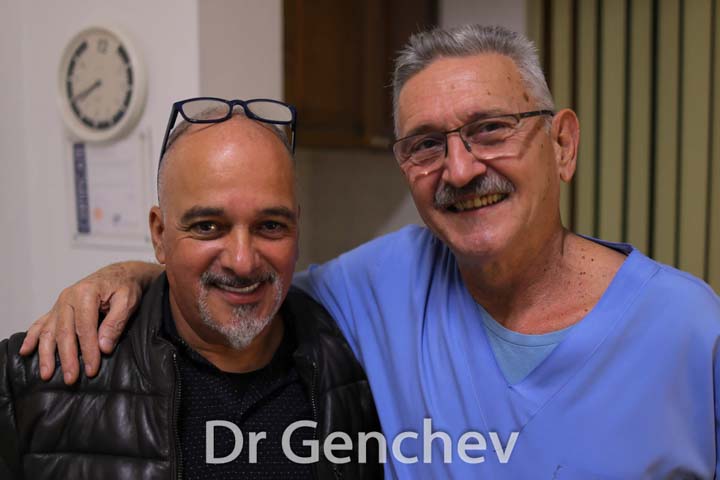
Dr. Genchev brings exceptional experience to his basal implant practice in Plovdiv, Bulgaria. With 40 years as a dentist, he represents one of the most experienced practitioners in Europe. His journey into basal implantology began after 15 years of practicing conventional implantology, giving him a comprehensive understanding of both approaches and why basal implants deliver superior results for complex cases.
For the past 12 years, Dr. Genchev has specialized exclusively in basal implantology, performing hundreds of full mouth reconstructions for patients with advanced gum disease, severe bone loss, and complex dental conditions.
His practice in Plovdiv serves patients from across Europe, particularly from France, Germany, the UK, and other Western European countries where basal implantology is either not available or prohibitively expensive. Dr. Genchev’s treatment cost of €9,990 for complete restoration of both jaws represents exceptional value, especially when compared to the €40,000 that the same treatment would cost in France.
Medical Disclaimer & Review
This article was produced by The Dentist Marketing Agency for educational purposes and was medically reviewed by Dr. Genchev on August 16, 2026, to ensure clinical accuracy. Dr. Genchev specializes in the full dental restoration protocol, which utilizes basal implants to rehabilitate edentulous patients with severe bone loss without the need for bone grafting. Dr. Genchev ensures that all descriptions of the implantation technique, the €6,500 pricing for one jaw and the single visit of 5 days treatment timeline reflects current clinical practice and safety standards.
Last Updated: 08-16-2026