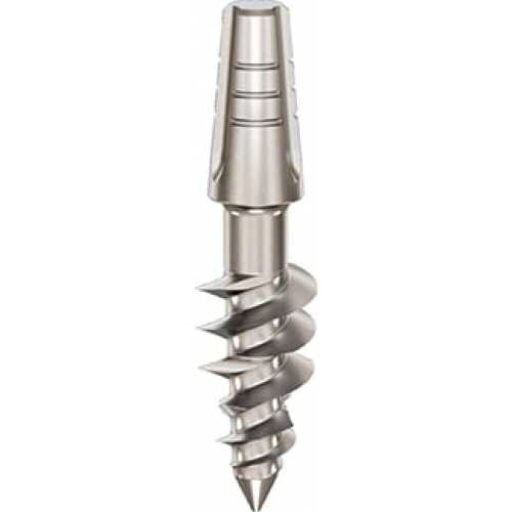
Dr. Genchev, a basal implantologist with 40 years of dental experience practicing in Plovdiv, Bulgaria completed in just 5 days a full-mouth restoration for a French patient suffering from severe periodontitis. And there was no need for a bone graft, nor zygomatic implants. And it was 4 times cheaper than in France.
Clinical Diagnosis: The patient presented with Advanced Chronic Periodontitis (classified under ICD-10: K05.3), characterized by systemic tooth mobility and significant alveolar bone loss.
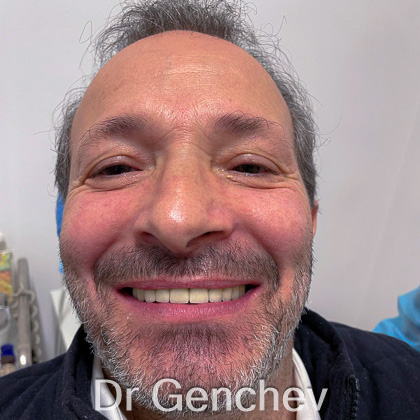
The Effects of Periodontitis
How does advanced gum disease impact everyday life?
Marc came to Dr. Genchev with advanced periodontitis. Every tooth in his mouth was loose. Eating was painful. Chewing normally was impossible. The inflammation that had quietly attacked his gums for years had eaten away at the bone supporting his teeth, leaving them with no stable foundation. He wanted two things above all: to chew normally again and to recover the smile he had when he was younger.
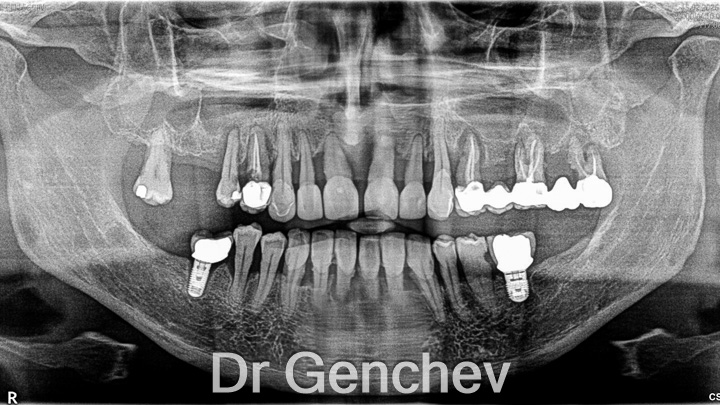
The panoramic X-ray told the full story. In the upper jaw, all the teeth were loose. The soft cancellous bone was porous and unreliable. Granulomas, pockets of infection, had formed at the roots of teeth 14, 22, and 24. In the lower jaw, the remaining teeth from positions 11–15 and 21–25 were also loose due to severe bone resorption. Two conventional implants that had previously been placed in positions 16 and 26 were stable but not connected to the remaining teeth, making them vulnerable to micro-movements.
Conventional Implant Dentists in France Said: “Non!”
Do I really need bone grafting and zygomatic implants to fix my upper jaw?
Dentists in France had assessed Marc’s upper jaw and delivered a daunting verdict: bone grafting procedures and zygomatic implants would be required to rehabilitate the maxilla. The estimated cost for this approach in France was €40,000. And that figure came with no guarantee. Bone grafting carries a well-documented failure risk, particularly in patients whose bone density has already been compromised by periodontal disease.
This is a common problem with conventional implantology. The All-on-4 and All-on-6 systems depend on the soft cancellous bone that is damaged by the periodontitis. When that bone is porous or absent, conventional implants cannot take hold. Bone grafts are then proposed as a workaround. But in patients with active gum disease, the inflammation increases the chance of bone graft failure. And, Marc wanted a solution that would be successful.
Watch this video before and after the dental restoration of Marc de France,
who suffered from advanced periodontitis
and was successfully treated with basal implants by Dr. Genchev. Watch it also on YouTube.
Basal Implants with Dr Genchev
How can basal implants work when there isn't enough bone for conventional implants?
Basal dental implants are different from conventional implants. Instead of anchoring in the soft cancellous bone that periodontitis destroys, they reach deeper into the hard cortical bone, a dense, stable layer that remains largely intact even in patients with severe gum disease and bone loss. This is what made Dr. Genchev’s treatment plan possible.
With 40 years of dental experience, including 15 years of conventional implantology and 12 years specialising exclusively in basal implantology, Dr. Genchev has treated hundreds of patients whose cases were refused by conventional dentists.
Upper Jaw: 17 Basal Implants Against the Odds
Why did Marc need so many implants in his upper jaw?
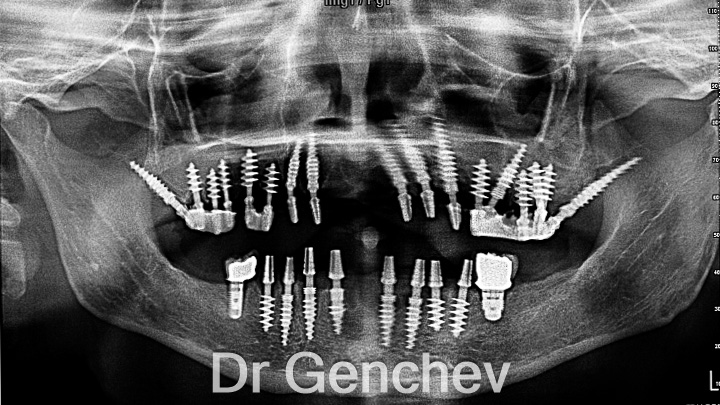
For the upper jaw, the bone was porous and had in some areas low-density, it was the dense cortical bone structure, qualified as bone type D3 (Thin porous cortical bone | SNOMED CT 21381000) and D4 (Fine trabecular bone | SNOMED CT 21381000). Dr. Genchev placed 17 basal implants, 8 on the right side and 9 on the left. More implants were needed to distribute the load and provide stability to support a full fixed bridge.
Dr. Genchev concentrated implants at the back of the upper jaw, using positions 11–17 on the right and 21–27 on the left. He selected wider implants with an aggressive, sharper thread design. They are designed to grip porous bone more effectively. Two tubero-pterygoid implants, Ihde Dental TPG Uno, one on each side, were placed behind the sinuses into the pterygoid process of sphenoid bone (Classification: SNOMED CT 72891007) to recreate molar function.
In the frontal area Dr Genchev combined BCS and TPG Uno and fixed the implants in the nasal cortex.
- Dentist : Dr Genchev
- Patient : Gum Disease
- Treatment : Full mouth dental implant
- Dental Implant : Basal Implant IhdeDental
- Location : Plovdiv Bulgaria
- Time : 1 visit 5 days
- Price : €9990 Euro
Lower Jaw: 8 Basal Implants
Can existing conventional implants be integrated into a basal implant restoration?
The lower jaw was in better condition. Dr. Genchev placed 8 basal implants in positions 31, 32, 33, 35, 41, 42, 43, and 45. Crucially, he kept the two existing conventional implants. He used them as additional support for the bridge.
The lower jaw was in better condition. The bone density varied, from the dense cortical bone structure, qualified as bone type D3 (Thin porous cortical bone | SNOMED CT 21381000) and D4 (Fine trabecular bone | SNOMED CT 21381000). Dr. Genchev placed 8 basal implants anchored to the hard cortical bone in positions 31, 32, 33, 35, 41, 42, 43, and 45. He combined TPG Uno and Ihde Dental BCS. Crucially, he kept the two existing conventional implants. He used them as additional support for the bridge.

Dr Genchev
basal Implant Dentist
Dr Georgy Genchev treats the most complex patients that have no teeth and total bone loss.
His patients come from the USA, Canada, France, Belgium and Switzerland because he treats the patients that other dentists cannot help.
Recreating Marc’s Smile
Is it possible to have the same smile as before?
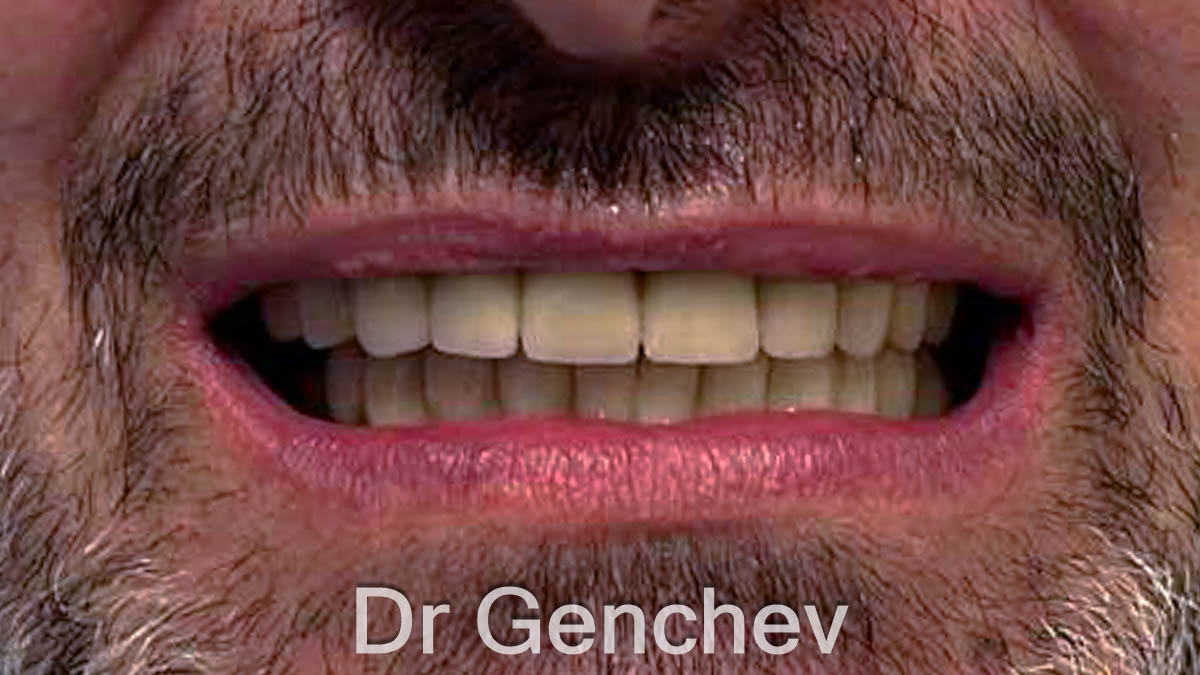
The bridges fitted to both jaws were constructed with PFM metal-ceramic crowns. It combines durability and aesthetics. Each bridge has 14 crowns to restore full function to chew normally with the molars. The shade selected was A2, a natural off-white that closely mimics real tooth enamel.
The crowns were not simply functional replacements. They were specifically designed to reproduce the shape and appearance of Marc’s original teeth. He wanted the same smile as when he was a younger man. This is the dual achievement Dr. Genchev set out to accomplish: functional restoration of both jaws, and aesthetic restoration of the patient’s identity.
Cost Savings
How much can be saved by choosing basal implants in Bulgaria instead of conventional treatment in France?
Dr. Genchev’s price for a full-mouth restoration was completed is €9,990. In France, the same scope of treatment was quoted at €40,000. That is a saving of €30,000 for a treatment that was completed faster, with no bone grafting risk.
Medical Disclaimer & Review
This article was produced by The Dentist Marketing Agency for educational purposes and was medically reviewed by Dr. Genchev on September 03, 2026, to ensure clinical accuracy. Dr. Genchev specializes in the full dental restoration protocol, which utilizes basal implants to rehabilitate edentulous patients with severe bone loss or gum disease without the need for bone grafting. Dr. Genchev ensures that all descriptions of the implantation technique, the €9,990 pricing for both jaws and the single visit of 5 days treatment timeline reflects current clinical practice and safety standards.
Last Updated: 09-03-2026
How to book a consultation?
Ask for a call back from Dr Genchev
Ask Dr Genchev for a consultation for a dental restoration with basal dental implants. Dr Genchev will explain the treatment plan based on your dental condition and provide a price for the treatment.
Request a call
Treatment Overview
Dental restoration with basal dental implants:
- Treatment: Rehabilitation of 1 or 2 jaws.
- Dental condition: Dr Genchev treats gum disease, bone loss, and total edntulism.
- Price: Depending on the treatment.
- Location: Plovdiv, Bulgaria.
- Time: 5 days.
By completing the enquiry form you agree to Dr Genchev’s team contacting you. The Basal Dental Implant Association does not endorse any dentist featured on its website. And it is not responsible for your choice of dentist and dental treatment.