How Dr Genchev succeeded with basal implants where other dentists gave up?
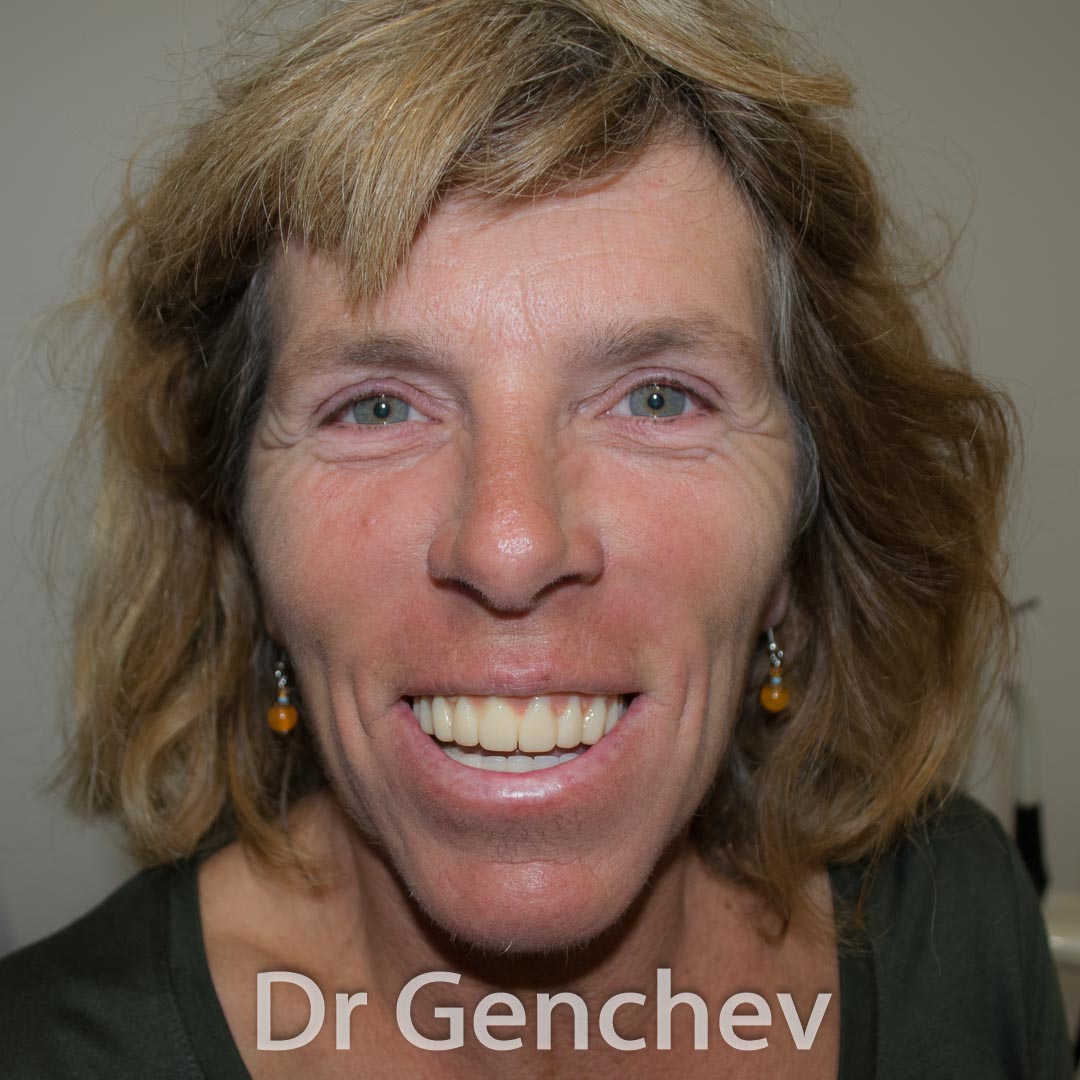
Dr. Genchev transformed Aline’s life in just 5 days with basal implants, completing the lower jaw restoration that another basal implant dentist had declared too difficult. This French patient suffered from extreme bone atrophy on her lower jaw. It was so severe that even after successfully completing her upper jaw restoration, the first dentist refused to treat the lower jaw, citing inadequate bone. The soft cancellous bone had completely resorbed, leaving only the thin cortical bone layer. For just €6,500, Dr. Genchev placed 8 strategically positioned basal implants and delivered a complete dental bridge with 14 composite crowns. His 40 years of dental experience and 12 years specializing in basal implantology enabled him to solve a problem that seemed impossible, demonstrating how basal implants succeed in the most challenging bone loss cases.
Clinical Diagnosis: The patient presented with Partial Edentulism complicated by Generalized Alveolar Ridge Atrophy (Classification: ICD-10 K08.40, M27.0 | SNOMED CT 25540007, 307779007). Clinical signs include the absence of natural dentition in the lower arch alongside significant vertical and horizontal bone loss of the mandible.
No solution with another dentist
What made the lower jaw too difficult for the first dentist?
Aline’s dental situation represented one of the most challenging cases in basal implantology. While her upper jaw restoration had been successfully completed by another basal implant dentist using 10 implants, her lower jaw presented extreme difficulties. The remaining teeth were loose and unstable, held together only with a temporary splint. The front center area from tooth positions 33 to 45 showed loosening teeth, while the back areas on both sides suffered from complete bone loss.
The critical problem was that the soft cancellous bone on the lower jaw had fully resorbed. In normal dental anatomy, this soft bone surrounds the tooth roots and provides the primary foundation for conventional implants. When teeth are lost, this cancellous bone disappears within 18 months through a process called bone resorption. Only the deeper cortical bone remains like a hard compact bone layer that provides structural support to the jaw.
For Aline, this bone situation proved too technically demanding for the first dentist. Despite his experience with basal implants, he lacked the confidence and specialized skills needed to work exclusively with such thin cortical bone. The implant placement would require extreme precision, navigating through minimal bone width while avoiding nerve damage. He made the professional decision to refer Aline to Dr. Genchev, knowing that this case demanded the highest level of expertise.

Dr Genchev
basal Implant Dentist
Dr Georgy Genchev treats the most complex patients that have no teeth and total bone loss.
His patients come from the USA, Canada, France, Belgium and Switzerland because he treats the patients that other dentists cannot help.
Dr Genchev’s Expertise
Why could Dr Genchev succeed where another dentist failed?
Dr. Genchev brings 40 years of dental experience to every case, with a unique background that sets him apart. He practiced conventional implantology for 15 years, mastering the traditional techniques before discovering basal implantology 12 years ago. This dual expertise gives him deep understanding of both conventional and basal approaches, allowing him to handle the most complex cases with confidence.
His extensive experience with severe bone loss treatment means he regularly treats patients whom other dentists have turned away. While many basal implant dentists limit themselves to straightforward cases, Dr. Genchev specializes in the technically demanding situations where only cortical bone remains. His steady hands and precise surgical technique enable him to place implants in bone that other dentists consider too thin or too risky.
Dr. Genchev practices from his clinic in Plovdiv, Bulgaria 🇧🇬. He has built a reputation across Europe for successfully treating the most challenging bone loss cases. French patients like Aline often travel to his clinic because no dentist in France, conventional or basal, will accept their cases. His pricing of €6,500 per jaw makes advanced treatment accessible, especially compared to France’s €20,000 cost for the same procedure.
Watch the video of this case study for Aline’s lower jaw restoration
with basal implants by Dr Genchev
The Strategic Implant Placement Plan
How did Dr Genchev position the implants in such thin bone?
Dr. Genchev’s success with Aline’s lower jaw came from his strategic implant placement strategy. He positioned 8 basal implants along the entire length of the jaw, distributing them evenly to provide optimal support and stability for the dental bridge. This comprehensive approach differs significantly from conventional implant All-on-4 systems that use only 4 implants concentrated at the front.
On the lower jaw, the soft cancellous bone had nearly completely resorbed. There remained the hard cortical bone, the dense cortical bone structure, qualified as bone type D1 (Dense Bone | SNOMED CT 36173007) and D2 (Trabecular Bone | SNOMED CT 122557009).
The implant distribution followed a precise pattern: 4 implants on the left side and 4 on the right, with 2 in the central areas and 2 in the back areas. Specifically, he placed 2 implants in tooth positions 33-34, 2 implants in positions 43-44, 2 implants in positions 36-37, and 2 implants in positions 46-47. The basal dental implants were anchored into the Mylohyoid line. This even spacing creates balanced force distribution when chewing, preventing stress concentration that could lead to implant failure.
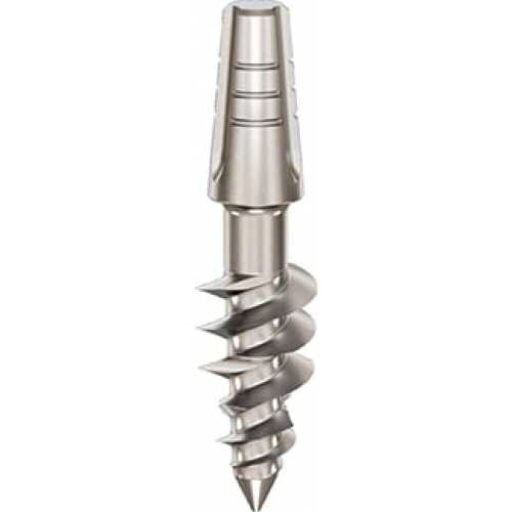
Dr. Genchev selected 🇨🇭 Ihde Dental brand implants. He combined Ihde Dental BCS and TPG Uno models. These one-piece basal implants are designed to anchor in cortical bone. Their longer length allows them to reach deep into the hard bone layer.
The 8-implant configuration provides the same stability as the 10 implants used in Aline’s upper jaw. Despite using fewer implants, the lower jaw restoration achieved excellent equilibrium because the cortical bone provides more reliable anchorage than the cancellous bone typically available in the maxilla.
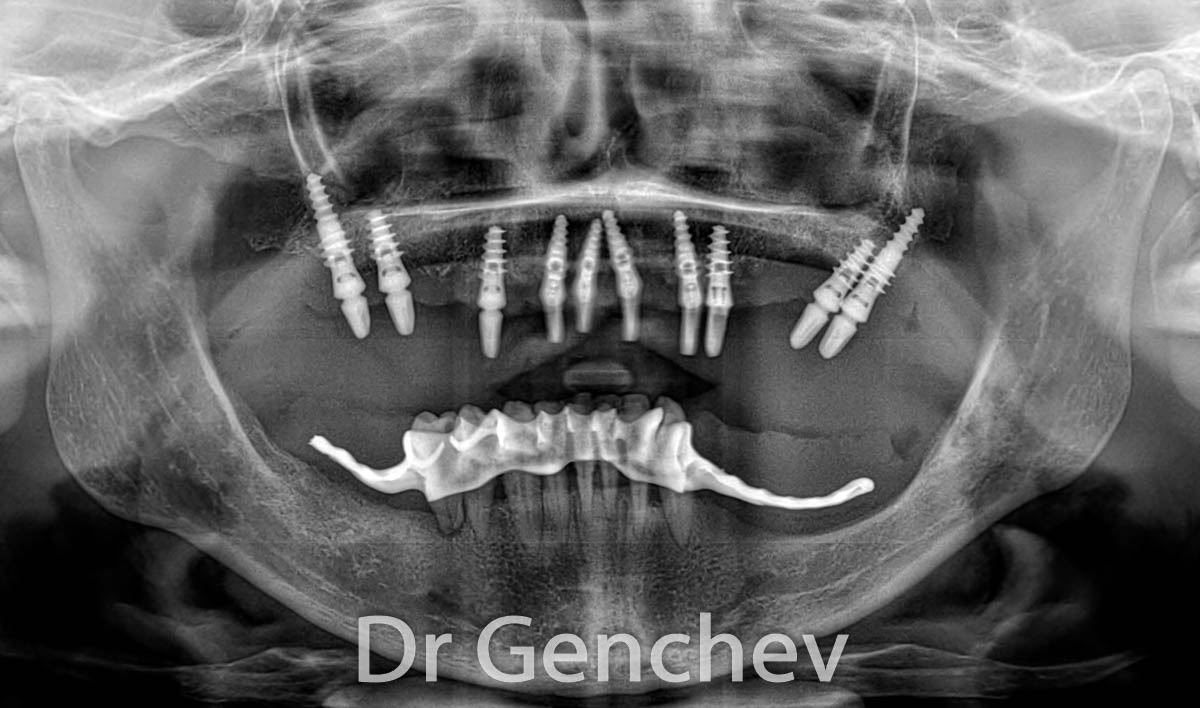
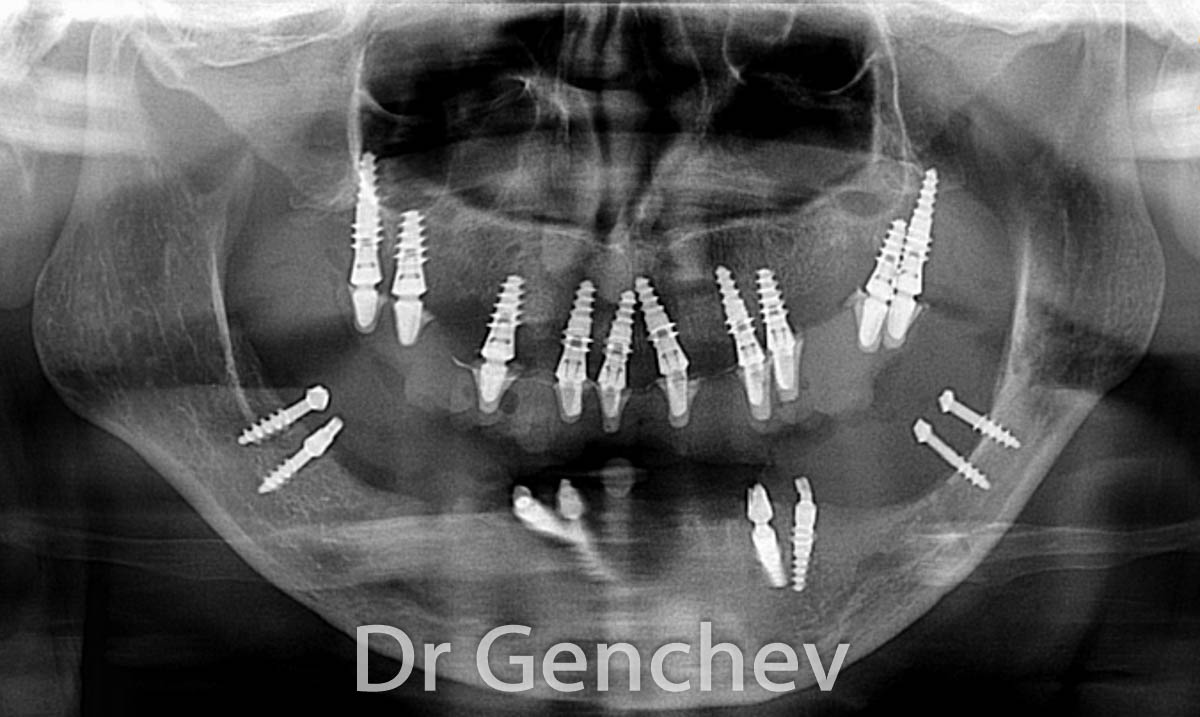
The implant distribution followed a precise pattern: 4 implants on the left side and 4 on the right, with 2 in the central areas and 2 in the back areas.
At the back of the jaw, in positions 36-37, and in positions 46-47, he anchored two implants on each side in the Mylohyoid line.
In positions 33-34, and positions 43-44 he placed another 2 implants that were evenly distributed to balance the forces of mastication when chewing, preventing stress concentration that could lead to implant failure.
Treatment Timeline
How quickly can I get my new teeth with basal implants?
Aline’s entire lower jaw restoration took just 5 days from start to finish. This rapid timeline represents one of basal implantology’s greatest advantages over conventional implants, which would require 8-12 months for similar cases with bone loss.
- Day 1: Dr. Genchev performed the complete implantation procedure. He first extracted all remaining loose teeth from the lower jaw, removing the temporary splint that had been holding them together.
- Day 3: brought an important milestone: the test fitting of the dental bridge structure.
- Day 5: Aline received her permanent dental bridge. Dr. Genchev securely attached the bridge with 14 composite crowns to the 8 implants, checking the occlusion and making final refinements.
Crown Selection
What type of crowns work best for severe bone loss cases?
Aline chose composite crowns for her lower jaw restoration, specifically requesting they match the composite-made bridge already present in her upper jaw. This material choice demonstrates the importance of aesthetic continuity across both dental arches. Composite crowns are made from resin materials that combine durability with natural appearance, and they’re particularly suitable for patients with compromised bone density due to their lighter weight.
The color selection process was equally important. Aline selected shade A2, a natural tooth color that harmonizes beautifully with most complexions. This shade provided the perfect match to her existing upper jaw bridge, creating a unified smile appearance. The 14 crowns were carefully shaped and sized to fit her facial structure and provide proper lip support.
- Dentist : Dr Genchev
- Patient : Bone Atrophy
- Treatment : Full mouth dental implant
- Dental Implant : Basal Implant IhdeDental
- Location : Plovdiv Bulgaria
- Time : 1 visit 5 days
- Price : €9990 Euro
Cost Savings
How much money did I save by traveling to Bulgaria for treatment?
The financial comparison between treatment in France versus Bulgaria reveals dramatic savings. Aline paid €6,500 for her complete lower jaw restoration with Dr. Genchev in Bulgaria. The same treatment in France, if she could even find a dentist willing to accept her case, would cost approximately €20,000. This represents a savings of €13,500 on the lower jaw alone.
Time Savings
How much time will I save compared to conventional implant treatment?
The timeline comparison between basal implants and conventional approaches reveals equally impressive advantages. Aline’s complete lower jaw restoration required just one 5-day visit to Bulgaria. She arrived on Day 0, underwent implant placement on Day 1, had her bridge test-fitted on Day 3, and received her permanent teeth on Day 5. She returned home on Day 6 with a full set of functional teeth and could resume normal eating within a week.
Dr. Genchev in Plovdiv Bulgaria
What qualifications and experience should I look for in a basal implant dentist?
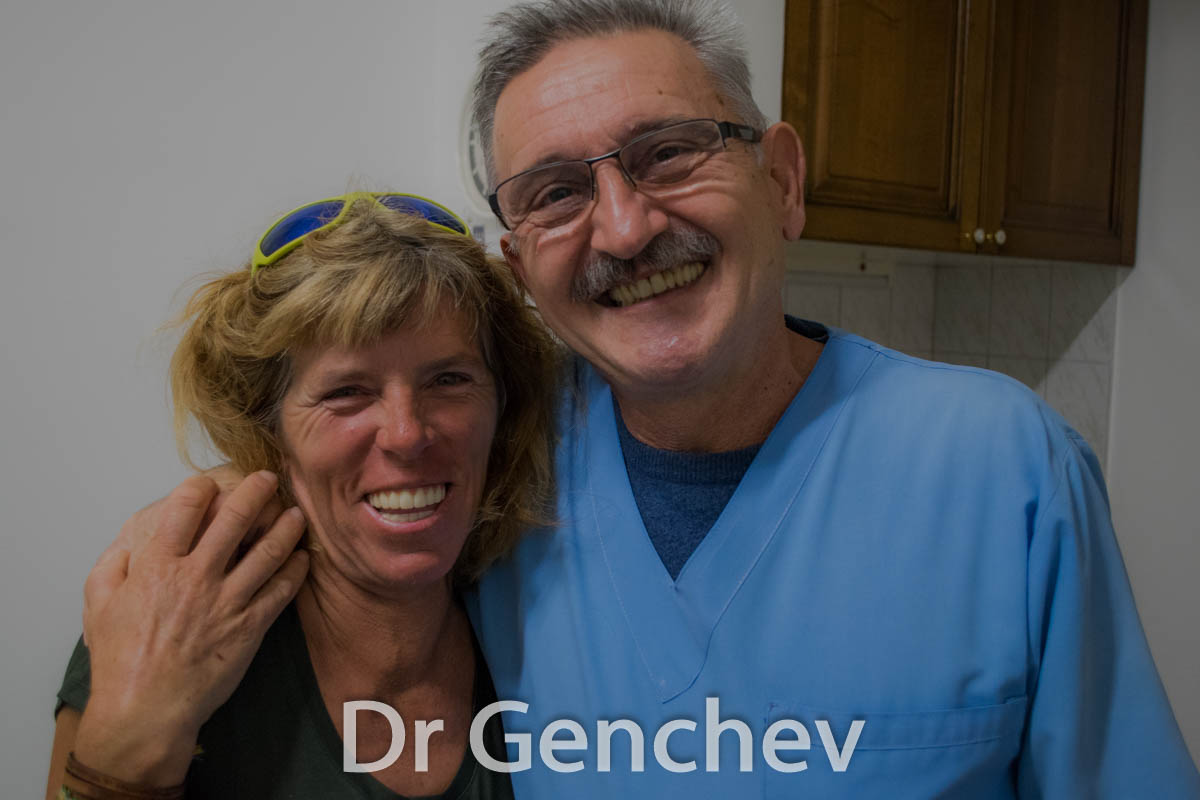
Dr. Genchev brings exceptional experience to his basal implant practice in Plovdiv, Bulgaria. With 40 years as a dentist, he represents one of the most experienced practitioners in Europe. His journey into basal implantology began after 15 years of practicing conventional implantology, giving him a comprehensive understanding of both approaches and why basal implants deliver superior results for complex cases.
For the past 12 years, Dr. Genchev has specialized exclusively in basal implantology, performing hundreds of full mouth reconstructions for patients with advanced gum disease, severe bone loss, and complex dental conditions.
His practice in Plovdiv serves patients from across Europe, particularly from France, Germany, the UK, and other Western European countries where basal implantology is either not available or prohibitively expensive. Dr. Genchev’s treatment cost of €9,990 for complete restoration of both jaws represents exceptional value, especially when compared to the €40,000 that the same treatment would cost in France.
Medical Disclaimer & Review
This article was produced by The Dentist Marketing Agency for educational purposes and was medically reviewed by Dr. Genchev on July 28, 2026, to ensure clinical accuracy. Dr. Genchev specializes in the full dental restoration protocol, which utilizes basal implants to rehabilitate edentulous patients with severe bone loss without the need for bone grafting. Dr. Genchev ensures that all descriptions of the implantation technique, the €6,500 pricing for one jaw and the single visit of 5 days treatment timeline reflects current clinical practice and safety standards.
Last Updated: 07-28-2026
How to book a consultation?
Ask for a call back from Dr Genchev
Ask Dr Genchev for a consultation for a dental restoration with basal dental implants. Dr Genchev will explain the treatment plan based on your dental condition and provide a price for the treatment.
Request a call
Treatment Overview
Dental restoration with basal dental implants:
- Treatment: Rehabilitation of 1 or 2 jaws.
- Dental condition: Dr Genchev treats gum disease, bone loss, and total edntulism.
- Price: Depending on the treatment.
- Location: Plovdiv, Bulgaria.
- Time: 5 days.
By completing the enquiry form you agree to Dr Genchev’s team contacting you. The Basal Dental Implant Association does not endorse any dentist featured on its website. And it is not responsible for your choice of dentist and dental treatment.