How basal implants restored Francoise’s teeth after conventional implants failed?
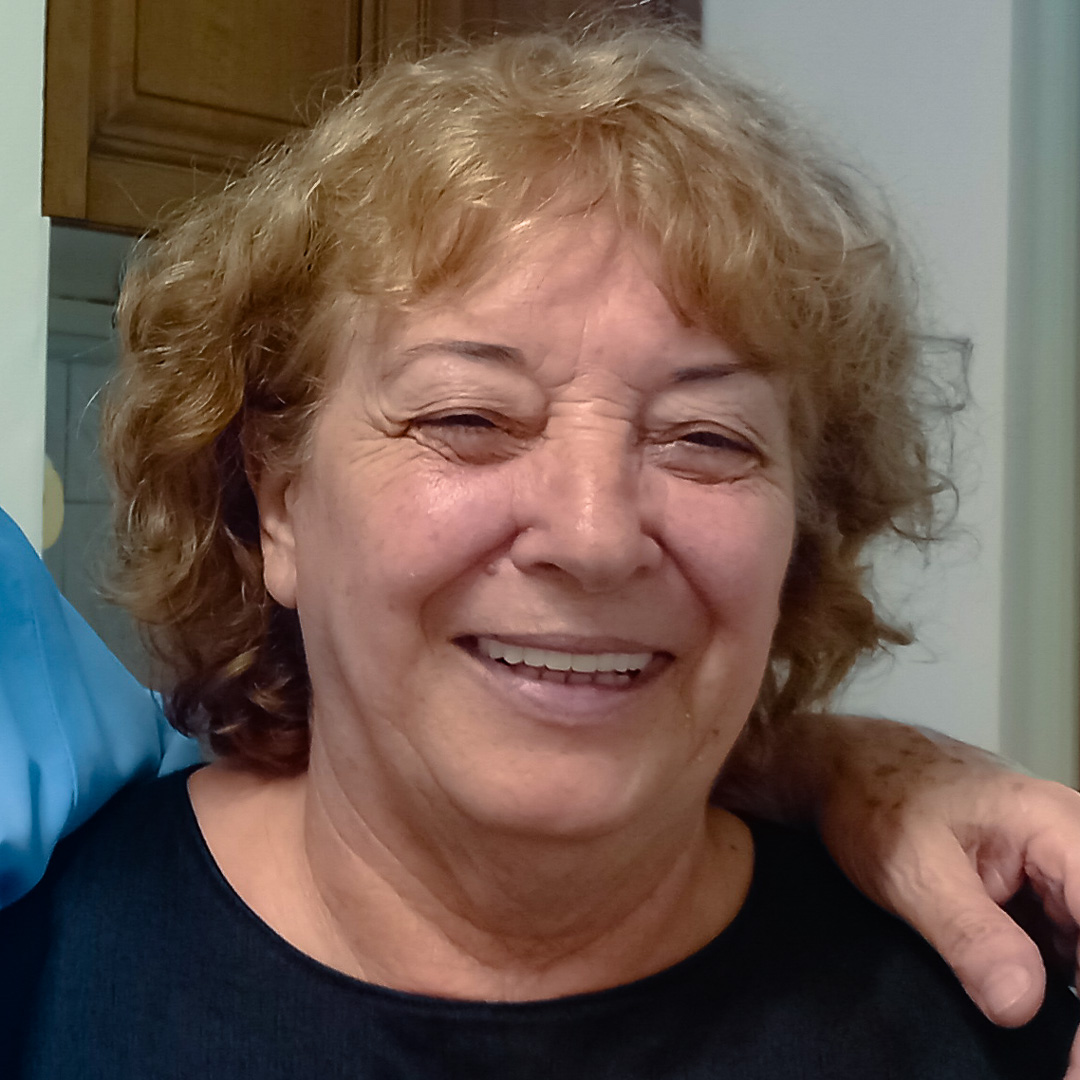
Dr. Genchev transformed Françoise’s life in just 5 days with basal implants after her All-on-6 procedure catastrophically failed, leaving her toothless for years. Françoise’s story demonstrates how basal dental implants succeed where conventional implantology fails, especially in cases of poor bone density. As a French patient who spent months without teeth after her conventional implants couldn’t be loaded, she traveled to Bulgaria and received complete restoration of both jaws for €9,990, a savings of €30,000 compared to France’s €40,000 cost, with most French implantologists refusing to even attempt her case due to poor bone quality.
Failed All-on-6
What caused the conventional implants to fail?
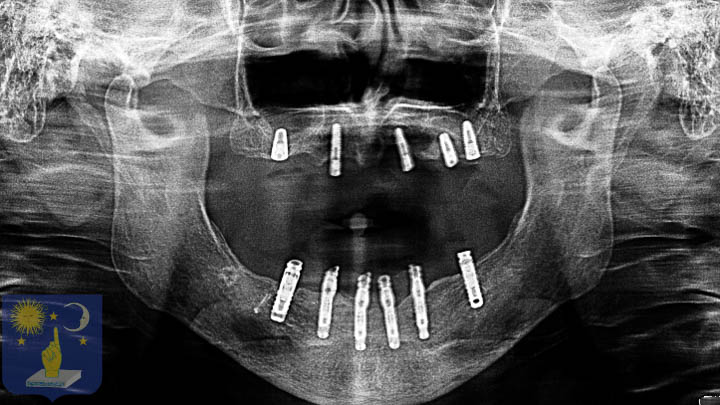
Françoise initially sought full mouth restoration through the popular All-on-6 system, which uses six conventional dental implants per jaw to support a bridge of 10 teeth. Her previous dentist extracted all her teeth and attempted to compensate for bone loss by adding bio-bone graft material. This is standard protocol in conventional implantology when patients lack sufficient bone density to support short conventional implants.
However, several months after placing the six conventional implants, a critical problem emerged: the implants could not be loaded with the dental bridge. The soft cancellous bone of her upper jaw simply did not have sufficient density to hold the implants and support the weight of a full bridge. The bio-bone powder from the bone grafting procedure never hardened into solid bone, remaining porous and weak.
The Consequences
Françoise remained completely toothless for several months while her dentist tried to determine what to do. This extended period without teeth caused severe problems beyond just the inability to eat normally. The bone in her upper jaw continued to shrink and lose volume because there were no teeth or functional implants to stimulate the bone cells.
Meanwhile, her lower jaw—where the conventional implants had been successful, widened and positioned itself in front of her upper jaw. This condition is called mandibular prognathism or underbite. The lower jaw essentially grew forward to compensate for the missing upper teeth, creating a serious bite misalignment that would need to be corrected in any future treatment.
After some time, one of the six upper implants simply fell out, confirming what the X-rays suggested: the bone was too soft and porous to hold conventional implants. Françoise faced the prospect of expensive bone grafting procedures or zygomatic implants with no guarantee of success, or living with dentures for the rest of her life. Most implant dentists in France refused to take her case, considering her bone quality too poor to risk another failure.
the Limitations of All-on-6
Why doesn't All-on-6 work for patients with poor bone density?
The All-on-6 system represents an improvement over the original All-on-4 approach by using six implants instead of four, providing more stability and support for the dental bridge. However, the fundamental design still relies on short conventional implants placed in the soft cancellous bone that holds natural tooth roots. When this bone has poor density or has resorbed significantly after tooth loss, conventional implants face serious stability challenges.
Conventional implants depend on a biological process called osseointegration, where the bone gradually fuses with the titanium implant over 4-8 months. This fusion provides the strength needed to support chewing forces. However, osseointegration requires healthy bone with adequate density and blood supply. In patients like Françoise with porous, poor-quality bone, this integration process fails or provides insufficient strength.
Watch the video of this case study for Francoise who suffered from a failed All-on-6
and was successfully treated with basal implants by Dr Genchev
Failed Bone Grafting
The bio-bone powder added during Françoise’s initial surgery was supposed to regenerate and harden into solid bone over several months. This works for some patients with moderate bone loss. However, in cases of severe bone atrophy or extremely poor bone quality, the body’s bone cells cannot effectively convert the graft material into strong, functional bone. The powder remains as a gel-like substance that provides no structural support.
Studies show that bone grafts fail in 20-30% of cases, with failure rates even higher in patients with poor bone quality, gum disease, or compromised healing. Even when grafts appear successful initially, they may not provide sufficient long-term support for the stresses of chewing with a full bridge on just six implants.
The Prognathism Problem
Another critical limitation of the All-on-6 system became evident in Françoise’s case: the inability to correct significant bite problems. Because conventional implants are short and placed at fixed positions dictated by available bone, dentists have limited flexibility to adjust the vertical dimension or position of the teeth. When Françoise’s lower jaw widened and moved forward during the years she remained toothless, the conventional implants could not be positioned to correct this underbite.
Basal implants solve this problem through their longer length and strategic placement, allowing the prosthetist to design bridges that correct bite alignment issues while restoring full function.
Successful Basal Implant Treatment
How did Dr. Genchev restore her teeth when conventional implants failed?
Dr. Genchev evaluated Françoise’s case and immediately recognized that conventional implant approaches were fundamentally unsuitable for her bone condition. Dr Genchev designed a treatment plan using longer basal implants that could bypass the problematic soft bone entirely and anchor into the hard cortical bone deeper in her jaw.
Upper Jaw Treatment Strategy
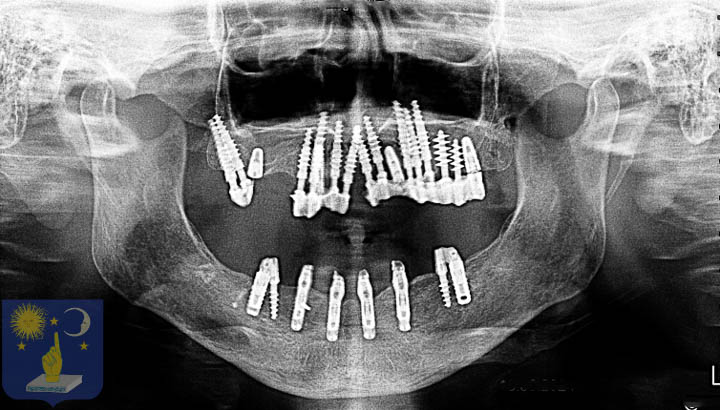
The bone quality on the upper jaw varied. There remained some cancellous bone, bone type D2. And there was hard cortical bone, the dense cortical bone structure, qualified as bone type D1 (Dense Bone | SNOMED CT 36173007), that Dr Genchev could use to anchor the dental implants.
Dr Genchev selected Ihde Dental implants 🇨🇭. He combined BCS and TPG Uno to achieve good stability and support for the dental bridge. He placed 13 new basal implants. He used two tubero-pterygoid implants, TPG Uno, behind the sinuses on the right side, plus 11 basal implants, Ihde Dental TPG Uno and BCS, to use the remaining cancellous bone and anchor them in the cortical bone of the nasal cortex. They were distributed across the center of the jaw between zones 11-14 and 21-26. This comprehensive distribution ensured even load distribution and provided the anchorage points needed to correct her bite alignment.
Dr. Genchev placed 13 basal implants in Françoise’s upper jaw, more than double the six conventional implants that had failed. This higher number was necessary for two critical reasons. First, distributing the chewing load across more implants reduces stress on each individual implant, crucial when bone quality is compromised. Second, the additional implants provide strategic positioning flexibility to correct the prognathism that had developed.
He removed one loose conventional implant in zone 25 that had failed completely. However, he made a strategic decision to keep the other four stable conventional implants that remained integrated in the bone. Rather than using them to support the bridge, Dr. Genchev left them in place to avoid creating additional surgical trauma.
The 13 new basal implants were positioned strategically: two tubero-pterygoid implants behind the sinuses on the right side, plus 11 basal implants distributed across the center of the jaw between zones 11-14 and 21-26. This comprehensive distribution ensured even load distribution and provided the anchorage points needed to correct her bite alignment.
Lower Jaw Integration Approach
Dr. Genchev took a hybrid approach with Françoise’s lower jaw. Because the six conventional implants placed during the failed All-on-6 procedure had successfully integrated and remained stable, he kept all of them as part of the foundation. However, he recognized that six implants alone provided insufficient support for optimal stability and bite correction.
He added two strategic basal implants in zones 33 and 43, where the canine teeth are normally located. These positions are critical for distributing lateral chewing forces and providing rotational stability to the bridge. The final lower jaw restoration was supported by a combination of six conventional implants and two basal implants, eight total support points that create exceptional stability.
This hybrid approach demonstrates the flexibility and intelligence of basal implantology. Rather than following a rigid protocol, Dr. Genchev assessed what was working (the stable lower conventional implants) and supplemented it with basal implants where additional support was needed.
Implant Selection and Specifications
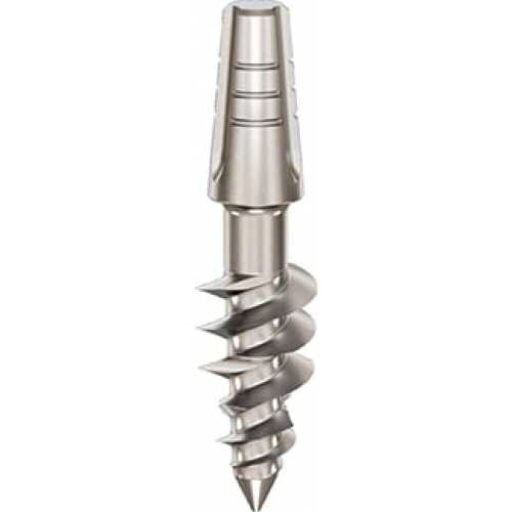
Dr. Genchev selected IhdeDental brand basal implants for Françoise’s treatment, specifically using Ihde Dental KOS ROOT and TPG Uno types. IhdeDental represents one of the leading manufacturers of basal implants, known for high-quality medical-grade titanium construction and a wide range of lengths and widths to suit different anatomical situations.
The KOS ROOT implants were used in the main anterior areas where standard basal placement was appropriate. The tubero-pterygoid implants are specialized longer designs that anchor behind the sinuses in the pterygoid bone at the back of the jaw. These implants are essential for recreating full molar function and avoiding sinus lift procedures entirely.

Dr Genchev
basal Implant Dentist
Dr Georgy Genchev treats the most complex patients that have no teeth and total bone loss.
His patients come from the USA, Canada, France, Belgium and Switzerland because he treats the patients that other dentists cannot help.
Correcting the Prognathism
How did Dr. Genchev fix the underbite?
One of the most impressive aspects of Françoise’s treatment was the correction of her mandibular prognathism through strategic bridge design. This demonstrates a key advantage of basal implants that conventional implants cannot offer: the ability to modify tooth position and bite alignment without orthodontics or jaw surgery.
Innovative Bridge Design
Dr. Genchev instructed his prosthetist to create custom-designed dental bridges that would correct the underbite while restoring full chewing function. For the upper jaw bridge, the crowns were slightly inclined forward, bringing them into the proper position in front of the lower teeth. Simultaneously, the lower bridge crowns were slightly inclined backward, retreating from their forward position.
This coordinated modification resulted in the upper front teeth positioning correctly in front of the lower front teeth—the normal, healthy bite relationship. The correction was achieved entirely through the bridge design rather than moving the jaw bones themselves, demonstrating the versatility that longer basal implants provide.
Restoring Full Mastication
Simply correcting the front tooth alignment wasn’t enough, Françoise needed to be able to chew normally with her back teeth. Dr. Genchev solved this by designing the upper bridge pre-molars and molars slightly thicker on the chewing surfaces. This ensured full contact between upper and lower back teeth despite the bite correction in front.
The result was complete restoration of mastication functionality. Françoise could crush food properly with her molar teeth for the first time in years. This level of functional restoration is impossible with the All-on-6 system, which provides limited back tooth support and cannot easily correct significant bite misalignments.
Crown Material and Aesthetics
Françoise chose PFM (porcelain-fused-to-metal) metal-ceramic bridges for her restoration. This material selection was strategic given her history and needs. The strong metal base provides exceptional durability, important because there was concern she might grind her front teeth as she relearned how to chew normally after years without teeth.
She selected shade A1 for her new teeth, creating a bright, luminous off-white smile that looks noticeably white without being artificial. The rounded tooth shapes give a softer, more feminine appearance that complements her facial features. Each bridge consists of 14 crowns, providing a complete set of teeth from front incisors to back molars.
Dr. Genchev in Plovdiv Bulgaria
What qualifications should I look for in a basal implant dentist?
Dr. Genchev brings exceptional experience to his basal implant practice in Plovdiv, Bulgaria. With 40 years as a dentist, he represents one of the most experienced practitioners in Europe. His journey is particularly instructive, he practiced conventional implantology for 15 years before recognizing the limitations of that approach for complex cases and switching exclusively to basal implantology 12 years ago.
His practice in Plovdiv serves patients from across Europe, particularly from France, Germany, the UK, and other Western European countries where basal implantology is either not available or prohibitively expensive. Dr. Genchev’s treatment cost of €9,990 for complete restoration of both jaws represents exceptional value compared to the €40,000+ that similar treatment would cost in France, if dentists there would even attempt it.
The combination of his extensive experience, dual expertise in conventional and basal implantology, competitive pricing, and proven success in challenging cases attracts patients like Françoise who have been told they have no good options by conventional dentists in their home countries.
Medical Disclaimer & Review
This article was produced by The Dentist Marketing Agency for educational purposes and was medically reviewed by Dr. Genchev on July 28, 2026, to ensure clinical accuracy. Dr. Genchev specializes in the full dental restoration protocol, which utilizes basal implants to rehabilitate edentulous patients with severe bone loss without the need for bone grafting. Dr. Genchev ensures that all descriptions of the implantation technique, the €9,990 pricing for both jaws and the single visit of 5 days treatment timeline reflects current clinical practice and safety standards.
Last Updated: 07-28-2026
How to book a consultation?
Ask for a call back from Dr Genchev
Ask Dr Genchev for a consultation for a dental restoration with basal dental implants. Dr Genchev will explain the treatment plan based on your dental condition and provide a price for the treatment.
Request a call
Treatment Overview
Dental restoration with basal dental implants:
- Treatment: Rehabilitation of 1 or 2 jaws.
- Dental condition: Dr Genchev treats gum disease, bone loss, and total edntulism.
- Price: Depending on the treatment.
- Location: Plovdiv, Bulgaria.
- Time: 5 days.
By completing the enquiry form you agree to Dr Genchev’s team contacting you. The Basal Dental Implant Association does not endorse any dentist featured on its website. And it is not responsible for your choice of dentist and dental treatment.