Cancellous bone is the soft, spongy bone inside the jaw. It is the part most affected by tooth loss and the part that conventional implants depend on. Understanding how it behaves explains why some treatments need bone grafts and others do not.
Cancellous Bone For Basal Dental Implants
Cancellous bone, also called trabecular or spongy bone, sits underneath the hard cortical shell. It has a honeycomb structure and a rich blood supply, which makes it biologically active and good for healing.
But it is also much softer than cortical bone. On its own, it offers less mechanical grip for an implant. And after tooth loss, it is the first bone to disappear. Bone resorption, the breakdown and loss of bone tissue, mostly affects the cancellous layer.
Cancellous Bone Location
Which parts of my jaw are mostly cancellous bone?
Cancellous bone is present throughout both jaws, but it dominates in specific areas:
- The anterior maxilla (the front of the upper jaw)
- The premaxilla and the maxillary alveolar process
- The posterior maxilla, including the maxillary molar region, maxillary tuberosity and the area around the maxillary sinus floor
- Parts of the posterior mandible in some patients
- The alveolar process, the bony ridge that originally held the teeth
These are also the zones where bone loss is most visible on X-rays after teeth have been missing for some time.
Cancellous vs Cortical Bone
How does cancellous bone compare to the harder bone underneath?
The two bone types behave very differently in implant treatment:
| Feature | Cancellous bone | Cortical bone |
|---|---|---|
| Structure | Soft, spongy | Dense, compact |
| Location | Inside the jaw, near tooth sockets | Outer shell, deeper plates |
| Blood supply | High | Lower |
| Resorption after tooth loss | Significant within 18 months | Minimal |
| Role in conventional implants | Main anchorage | Limited |
| Role in basal implants | Secondary support if healthy | Primary anchorage |
Conventional implants rely mainly on cancellous bone. Basal implants treat it as helpful when present but never essential. That is why basal treatment still works when cancellous bone has resorbed.
Dental Conditions Linked to Cancellous Bone
Which conditions affect cancellous bone the most?
Several common conditions involve cancellous bone directly:
- Bone atrophy, the loss of bone density and volume associated with tooth loss and aging, mainly affects the cancellous layer
- Early tooth loss, before significant resorption has occurred, often still has healthy cancellous bone usable for primary stability
- Periodontal disease weakens the cancellous bone supporting the tooth before it reaches the cortical plates
- Sinus pneumatization in the upper back jaw, where the sinus expands into the space left by lost cancellous bone
Patients whose cancellous bone has resorbed are usually told they need bone grafting for conventional implants. Basal implants offer a different route.
Cancellous Bone and the D1 to D4 Classification
Where does cancellous bone fit into the density grades my dentist uses?
Dentists grade jawbone density on a scale from D1 to D4, based on the balance between cortical and cancellous bone:
- D1 bone: very dense cortical, very little cancellous
- D2 bone: porous cortical with strong cancellous bone inside
- D3 bone: thin cortical over fine cancellous bone
- D4 bone: mostly soft cancellous bone with little cortical support
Cancellous bone is the dominant component in D3 and D4 and a significant part of D2. In D4, especially, the implantologist has to think carefully because the cancellous bone alone cannot reliably hold an implant.
Implant Brands and Series for Cancellous Bone
Which implants are designed to use cancellous bone?
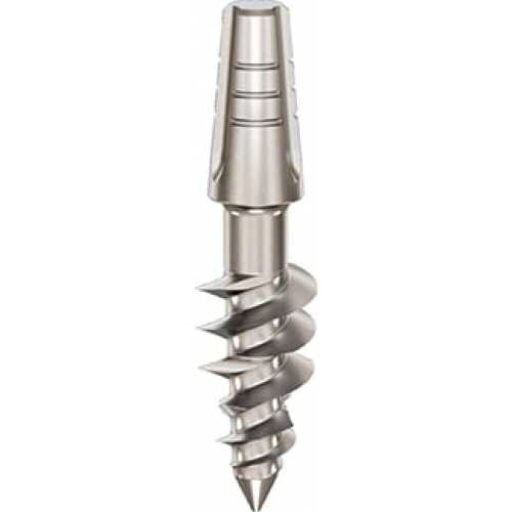
Some implant designs use cancellous bone for friction-based grip, often combined with cortical anchorage at the tip. The most relevant series are:
- Ihde Dental KOS ROOT: compresses cancellous bone for primary stability, can also reach the nasal floor cortex
- Ihde Dental TPG Uno: works in mixed zones, compressing cancellous bone while engaging cortical bone at the apex
- BasalFix Compressive: for healthy cancellous bone that can generate friction-based stability
- BasalFix Compressive-Fix: for transition zones in the anterior to mid-maxilla
- Monoimplant Rough: designed for softer D3 and D4 bone, with a surface that encourages osseointegration
- Monoimplant MOT: a hybrid design for maxillary and sinus-related cases
Each implant matches a specific bone condition. See all options on the basal implant brands page.
Case Study: Marie’s Treatment by Dr Genchev
Marie is a 🇫🇷 French patient with total edentulism and severe bilateral bone atrophy. Dr Genchev in 🇧🇬 Bulgaria treated her in five days, using different implants for different zones based on the bone available.
In Marie’s anterior maxilla, where cancellous bone was thin but present, Dr Genchev placed Ihde Dental KOS Root implants with a slight palatal angulation. The implants compressed the available cancellous bone and locked their tips into the nasal floor cortex above. This combined cancellous compression with cortical fixation.
Where both cancellous and cortical bone were available, he used TPG Uno implants. Where only hard cortical bone remained, he chose BCS. The case shows how cancellous bone can still play a useful role when it is healthy, and how the implant choice changes when it is not. Read more in the Dr Genchev bone atrophy case study.
Frequently Asked Questions on Cancellous Bone
What is bone resorption, and how does it affect my cancellous bone?
Bone resorption is the breakdown and loss of bone tissue. It mainly affects the cancellous bone close to the tooth socket and can happen within 18 months of tooth loss, which is why patients who have been missing teeth for years often have little cancellous bone left to support conventional implants.
Do I need a bone graft if my cancellous bone has resorbed?
Not with basal implants. They are placed directly into the dense cortical bone underneath, which removes the need for bone grafting or sinus lifts that conventional implants often require when cancellous bone alone is no longer enough.
Case Studies For Basal Dental Implants
and Cancellous Bone
-
Basal Implants for Gum Disease
Dr. Genchev placed 25 basal dental implants, two permanent metal-ceramic bridges, and recreated Marc’s smile when he was a younger man, in one single 5-day visit in Plovdiv Bulgaria.
-
Dr Genchev Lower Jaw Restoration
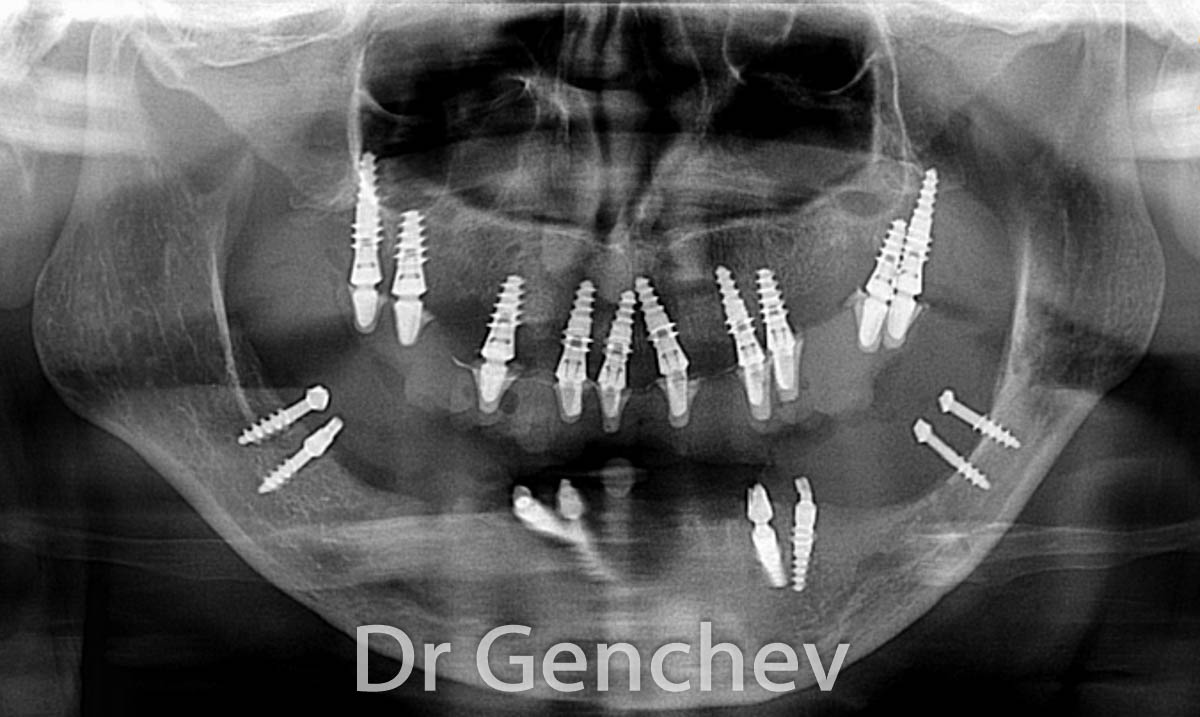
Dr. Genchev transformed Aline’s life in just 5 days with basal implants, completing the lower jaw restoration that another basal implant dentist had declared too difficult.
-
Dr Genchev Dental Restoration for Gum Disease
Dr. Genchev transformed Véronique’s life in just 5 days with basal implants, restoring her ability to eat without pain and giving her back a confident smile.