The Pyramidal Process
The pyramidal process is a downward and backward projection from the horizontal plate of the palatine bone. It is roughly pyramidal in shape, which gives it its name. It fits into the pterygoid notch, the space between the medial and lateral pterygoid plates of the sphenoid bone.
The pyramidal process (Latin: processus pyramidalis ossis palatini) is a bony projection from the palatine bone that fits into the notch between the pterygoid plates of the sphenoid bone. It is a compact, dense cortical structure that sits at the convergence of three bones: the palatine bone, the maxilla and the sphenoid. In dental implantation, it forms part of the cortical complex that makes posterior maxillary anchorage possible without sinus lift or bone graft.
Key anatomical relationships:
- Location: Posterior and inferior, at the junction between the palatine bone, the maxillary tuberosity and the pterygoid plates.
- Adjacent structures: Medial pterygoid plate (Latin: lamina medialis), lateral pterygoid plate (Latin: lamina lateralis), and the posterior surface of the maxillary tuberosity (Latin: tuber maxillae).
- Synonyms and alternative names: Pyramidal process of the palatine bone, tuberosity of the palatine bone (Latin: tuberositas ossis palatini). Not to be confused with the pyramidal eminence of the middle ear.
- Bone characteristics: Dense cortical bone. Because it is part of the palatine bone and articulates with the sphenoid, it shares the biomechanical stability of the skull base complex.
The pyramidal process is not directly visible in routine dental X-rays, though it can be identified on high-quality CBCT imaging. Its position at the confluence of three bones means it represents a compact, mechanically stable cortical anchor that does not resorb with tooth loss in the same way the alveolar ridge does.
The Bone Quality of the Pyramidal Process
Is the pyramidal process bone good enough to anchor an implant?
The pyramidal process is cortical bone. It is denser than the soft cancellous alveolar bone of the posterior maxilla and is mechanically more reliable. In terms of bone type classification, the pyramidal process, like the broader pterygoid complex it connects with, is closest to D1 or D2 cortical bone.
This is in contrast to the overlying posterior maxillary alveolar bone, which in many edentulous patients or patients with significant bone loss may be D4, very soft, fine trabecular bone with almost no cortical support. The local ridge may be resorbed to the point where conventional implant placement is not possible. But the pyramidal process, along with the pterygoid plates and the tuberosity-pterygoid junction, represents a cortical zone at depth that remains biologically stable.
One practical consideration for implantologists: because the pyramidal process is a smaller and more variable structure than the pterygoid plates, its exact position, size and the depth of bone available for implant engagement must be assessed individually using three-dimensional CBCT imaging. It is not a structure that can be reliably identified or targeted based on OPG alone.
The Pyramidal Process in Strategic Implantation
Why should an implant be directed toward the pyramidal process rather than the available local bone?
In the posterior upper jaw, the challenge for implant planning is almost always the same: the alveolar bone has resorbed, the sinus has expanded, and the bone remaining above the sinus floor is insufficient for conventional implants. The traditional answer is a sinus lift, a surgical procedure that elevates the sinus membrane and packs bone graft below it.
Strategic implantology offers an alternative by targeting the cortical structures that remain at depth in the posterior maxilla. These include the pterygoid process, the tuberosity-pterygoid junction and the pyramidal process of the palatine bone.
The pyramidal process plays a supporting role in this cortical complex. Implants placed in the mid-posterior maxilla, typically in the premolar and first molar zones, may be directed to engage the pyramidal process or the adjacent palatine bone structures, rather than relying on the depleted alveolar ridge above the sinus. This approach:
- Avoids the sinus entirely
- Uses bone that does not resorb
- Provides stable cortical anchorage for immediate loading
- Allows restoration of the posterior zone without months of bone graft healing
Planning this correctly requires the implantologist to map the pyramidal process position on a CBCT scan, calculate the implant length and angulation needed to reach it, and select an implant system that can deliver cortical fixation at that depth.
Implant Selection for Pyramidal Process Anchorage
Which implants are designed to engage the pyramidal process?
The implants used in this zone must be long enough to reach the cortical structure at depth and have the thread geometry to engage dense cortical bone rather than soft alveolar tissue.
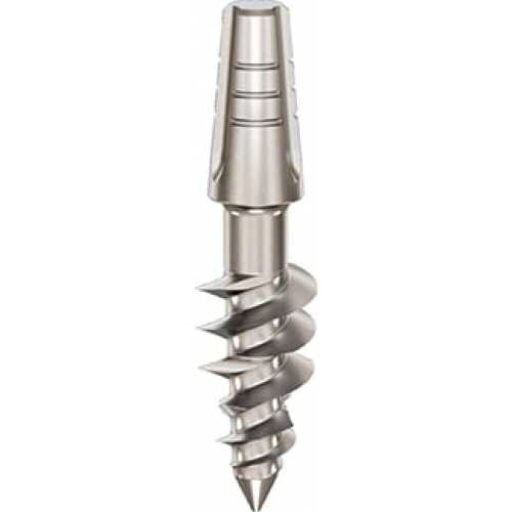
Ihde Dental TPG Uno has a direct documented connection to the pyramidal process in clinical case work. In Dr Genchev’s edentulism case study, a 3.5 x 12 mm TPG Uno implant at position 25 was described as being attached toward the pyramidal process. TPG Uno is specifically designed for zones where both cancellous compression and cortical fixation are available. Its triple-thread design compresses the cancellous bone body while the apical part engages cortical structures. This makes it applicable where the pyramidal process or the adjacent palatine bone cortex provides the deeper anchor.
Ihde Dental BCS can be directed toward the palatine bone cortical complex in cases where cancellous bone is absent and pure cortical anchorage is needed. In the right posterior maxilla of the same case study, BCS implants at positions 15 and 16 were anchored into the cortical bone of the vertical process of the palatine bone, the structure that is continuous with and adjacent to the pyramidal process. The wider 4.6 mm diameter was used to increase cortical contact and improve primary stability.
BasalFix TPI is engineered for the posterior maxillary cortical complex including the pterygoid-palatine junction zone. At the premolar zone in patients with adequate local bone, the TPI can be used as an intermediate bridge support, with its anchorage engaging the available cortical anatomy in the pyramidal process area.
BasalFix Basal can also be applied in the posterior palatine area where the second cortical plate is the primary anchorage target and cancellous bone is absent.
Case Studies About The Pyramidal Process
-
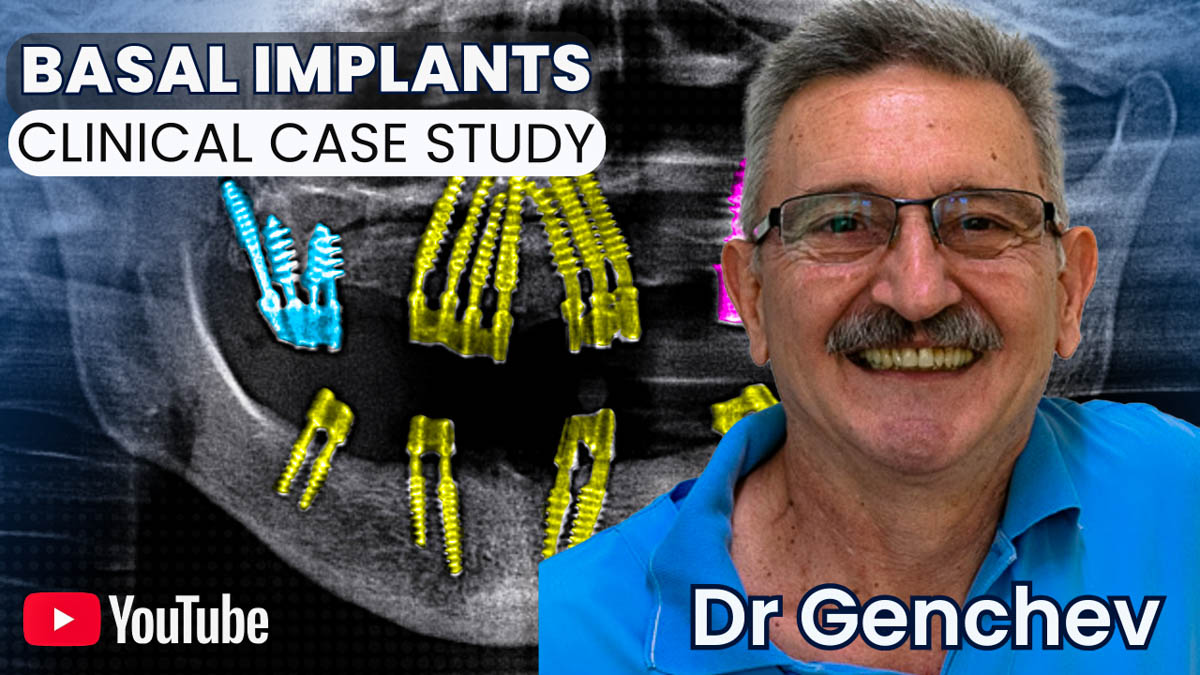
Basal Implants for Edentulism and Bone Atrophy
Clinical case study of Dr Genchev’s basal implant protocol for total edentulism and severe bone atrophy
-
Dr Genchev Dental Restoration for Gum Disease
Dr. Genchev transformed Véronique’s life in just 5 days with basal implants, restoring her ability to eat without pain and giving her back a confident smile.

-
Dental restoration for missing teeth and bone atrophy with basal implants
Dr Genchev completed the full mouth dental restoration for this patient who suffered from edentulism with severe bone atrophy in 1 visit of 5 days. The price for the full dental restoration was 8990 Euro.
