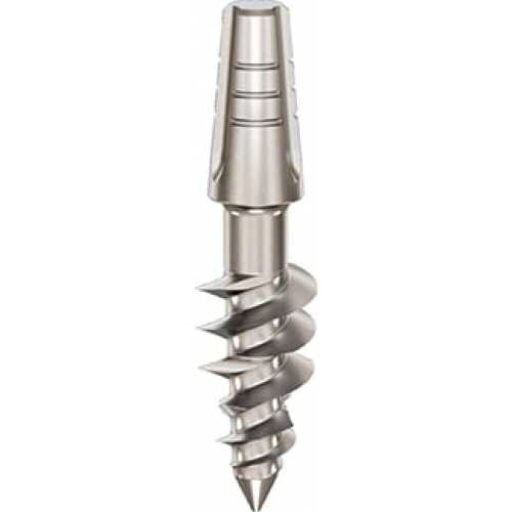
Why basal implants for gum disease?
Basal implants treat the symptoms of periodontal disease and restore the patient’s teeth. They resolve the symptoms of gum disease: loosening of teeth, tooth loss and bone loss.
Basal implants have the advantage of being longer and fixed into the hard cortical bone. They do not depend on the soft cancellous bone of the gums that disappears as a result of periodontal disease.

What is gum disease?
What are the symptoms of periodontitis?
Gum disease also known as periodontitis and periodontal disease, is an inflammation of the soft gum tissue around the roots of teeth. It is characterized by resorption of gum tissue, leading to loosening and then the loss of teeth. In the initial stage, periodontal disease can be controlled and, in some cases, cured. In the later stage, a full dental restoration with basal dental implants can counteract the symptoms of gum disease: the loosening of the teeth and loss of teeth.
Gum disease is characterized by resorption of the gums and loosening of the teeth. If left untreated, teeth begin to fall out. Over time, a chain reaction occurs, culminating in the loss of all the teeth – total edentulism.
Treatment for gum disease with basal dental implants
How can periodontitis be treated with basal implants?
Basal dental implants are the best solution for treating gum disease because they are longer and fixed in the cortical bone, which is harder and deeper than the root of the tooth. They do not depend on the soft cancellous bone of the gums. They are therefore unaffected by the gum resorption associated with gum disease.
Implant dentists specializing in basal implantology generally extract all teeth that are not stable. Some dentists prefer to keep the teeth that are stable and healthy. They are filed and used with implants to support the prosthesis.
Loosening of teeth
How can we prevent teeth from loosening?
When periodontal disease reaches the stage of tooth loosening, it’s necessary to extract unstable teeth and replace them with basal implants. Stable teeth can be retained and filed to support the fixed dental bridge.
The advantage of basal implantology for cases of gum disease is that all remaining teeth and basal implants are blocked under a full bridge of 14 crowns. It prevents the teeth from becoming loose. And, it helps regenerate the bone around the root of the teeth. As a result, the resorption of the cancellous bone associated with periodontitis is curtailed.
Tooth loss
How are the missing teeth replaced?
When periodontal disease reaches the stage of tooth loss, it is necessary to replace the teeth with basal dental implants.
In basal implantology, missing teeth are replaced by implants along the entire length of the jaw, including behind the sinuses. Pterygoid implants are fixed behind the sinuses to recreate the natural functionality of the mouth and allow the patient to chew normally with the molar teeth.
Bone Loss
How is the bone loss compensated without bone grafting or a sinus lift?
Basal implants are fixed into the hard cortical bone. It does not disappear with the loss of teeth, unlike the soft cancellous bone of the gums that recedes. Basal dental implants do not depend on the soft bone of the gums like conventional implants. So, there is no need to compensate for the bone loss with a bone graft or a sinus lift.
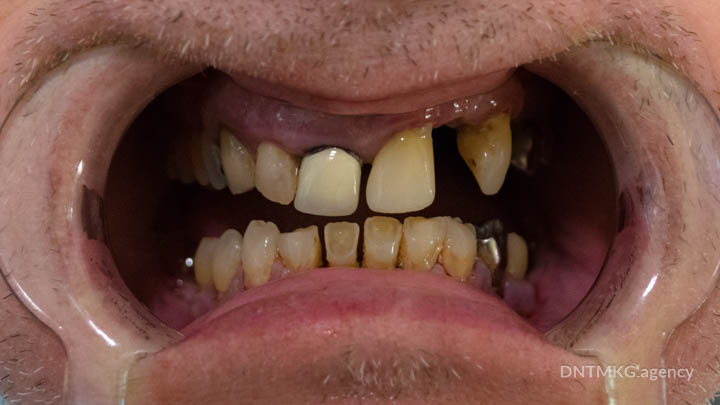
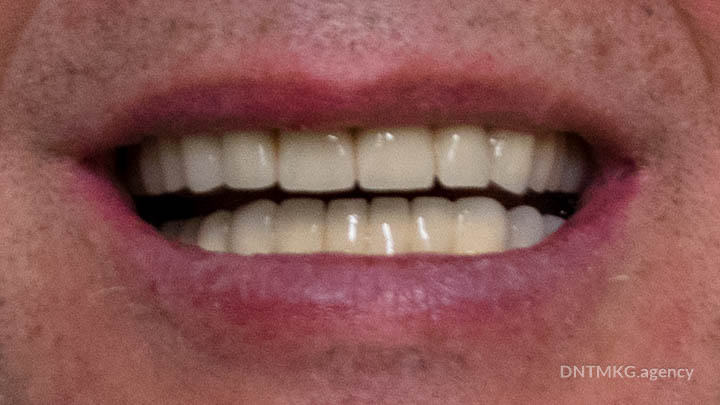
Before and After Basal Implants
to Treat Gum Disease
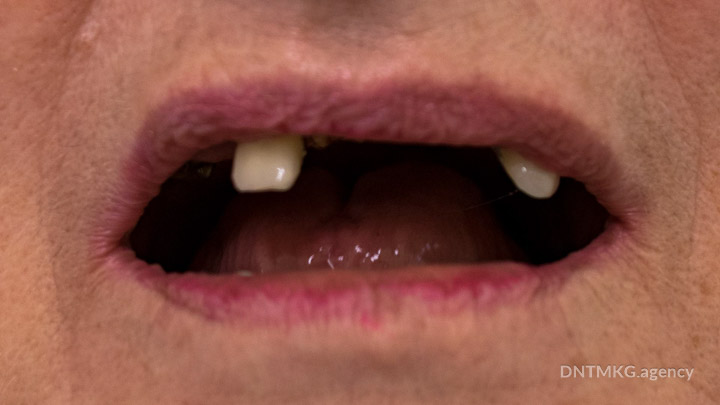
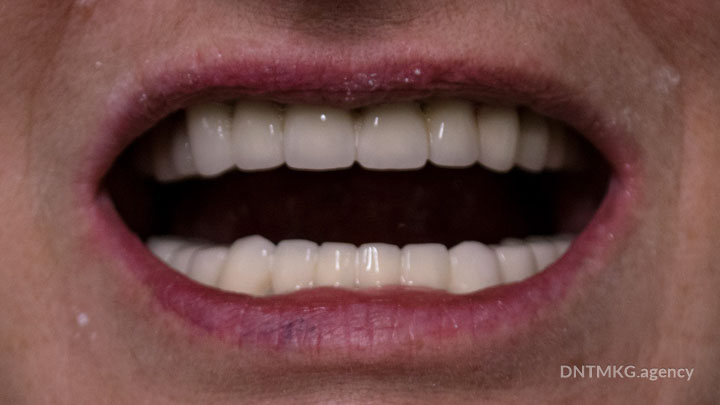
An example of a full mouth dental restoration for severe periodontitis with receding gums, loosening of the teeth and missing teeth.
The advantages of basal dental implants
What are the benefits of basal implants for treating periodontitis?
In cases of severe gum disease, the advantage of basal implants is that they compensate for bone loss, while avoiding sinus lift and bone grafting. Basal implants do not depend on cancellous bone. They are fixed deeper into the hard cortical bone.
Disadvantages of conventional dental implants
What are the limitations of conventional dental implants for treating periodontal disease?
One of the symptoms of periodontal disease is that the bone holding the teeth retracts, causing the teeth to loosen. Conventional implants are placed in this same cancellous bone, which resorbs and can cause traditional dental implants, that are too short, to loosen.
In patients with severe gum disease, the cancellous bone is not a reliable base to fix conventional dental implants. Due to the lack of spongy bone, dentists that practice conventional implantology recommend bone grafting and a sinus lift. But, for patients with advanced gum disease, these are expensive and useless procedures.
Limitations of the All on 4 system
What are the problems of using the All on 4 system to treat gum disease?
The All on 4 dental restoration system is not a good solution for patients with severe gum disease. The implants are too short and are placed in resorbing cancellous bone. What’s more, too few implants are placed. There are 4 to 6 on each jaw. And they are placed only at the front of the jaw. There are no implants behind the sinuses to replace the molar teeth that are made for chewing.
With the All on 4 and All on 6 system, it’s difficult to achieve a complete dental restoration for a patient suffering from severe gum disease. And, even if the implants set in the cancellous bone, there’s a risk of loosening when the bridge is loaded onto the implants. The All on Xtra system is an improvement with basal implants.
Comparison of basal and conventional dental implants for gum disease
Basal Implant

long implant
cortical bone
no resorption
Classic Implant

short implant
cancellous bone
bone resorption
Alternatives to dental implants
What are the alternatives to dental implants for treating periodontal disease?
It is difficult to replace missing or loosening teeth without using basal implants. The only alternative is total extraction of the teeth and fitting removable prostheses that are fixed with glue.
How is basal dental implantation performed?
What is the process for the dentist to place basal dental implants for patients with severe gum disease?
In cases of severe gum disease, basal dental implantation is performed in one five-day visit. The implant dentist will extract any teeth that are loose. Some dentists choose to keep teeth that are stable. They are filed to support the dental bridge. Missing teeth are replaced with basal dental implants. Basal implant dentists add implants along the entire length of the jaw to create anchors for the bridge.
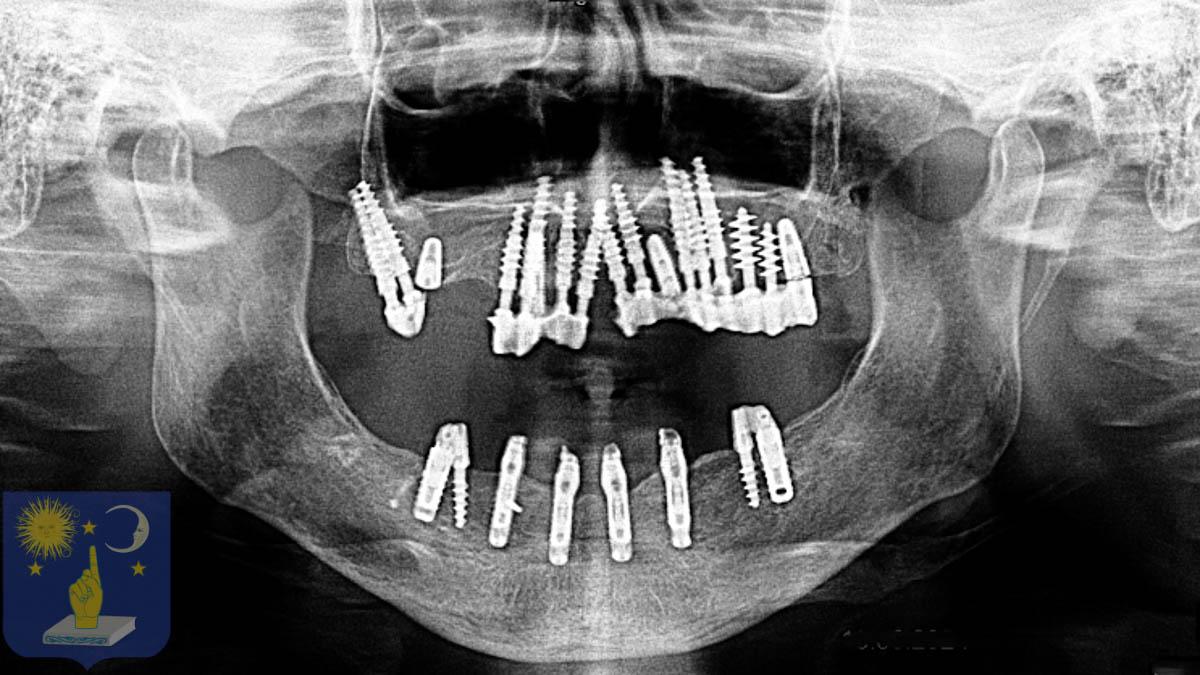
Typically, for patients who suffer from severe gum disease, the implant dentist places at least 10 basal implants on the upper jaw and 8 on the lower jaw. Some dentists prefer to keep healthy teeth that are unaffected by periodontal disease and only place basal implants where teeth are missing. In basal implantology the dentist places a full bridge of 12 to 14 crowns on each jaw.
How long does the basal implant procedure take?
Basal dental implants can be loaded immediately. The full dental restoration of both jaws takes only 1 visit of 3 to 5 days.
Medical Review & Editorial Integrity
Reviewed by Dr. Genchev, Master of Basal Dental implantology.
This content adheres to the Editorial Guidelines of The Basal Dental Implant Association. To ensure clinical accuracy, this page has been reviewed for medical integrity regarding basal implantology procedures, dental restoration protocol, and safety standards.
Last Updated: 02-02-2026
Results for basal dental implants
to treat gum disease

Patient Testimonials for
the treatment of periodontitis
Testimonials from patients who suffered from periodontal disease with tooth loss and receding gums that underwent a full mouth dental restoration with basal implants.
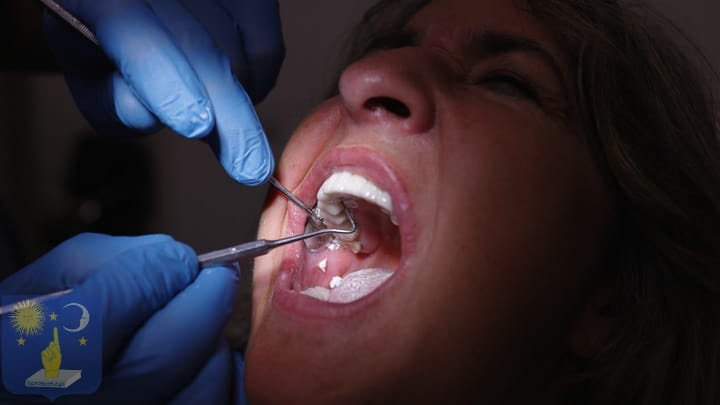
Photo of basal implants
to treat periodontal disease
Discover the photos of basal dental implants to treat gum disease with receding gums, missing teeth and bone atrophy.
Basal implants for gum disease
Photos before and after a full dental restoration with basal implants for patients suffering from severe periodontal disease.

Basal dental implants
for smokers
Basal dental implants are the only long-term solution for smokers. The heat of cigarettes damages the soft gum tissue that recedes. But, basal implants are fixed deeper into the hard cortical bone that does not recede.
Basal dental implants
for diabetes
Basal dental implants are recommended for patients who are diabetic because they are integrated into the cortical bone that is not affected by the effects of diabetes on the soft gum tissue.

Case Studies For Basal Dental Implants
-
Basal Implants for Gum Disease
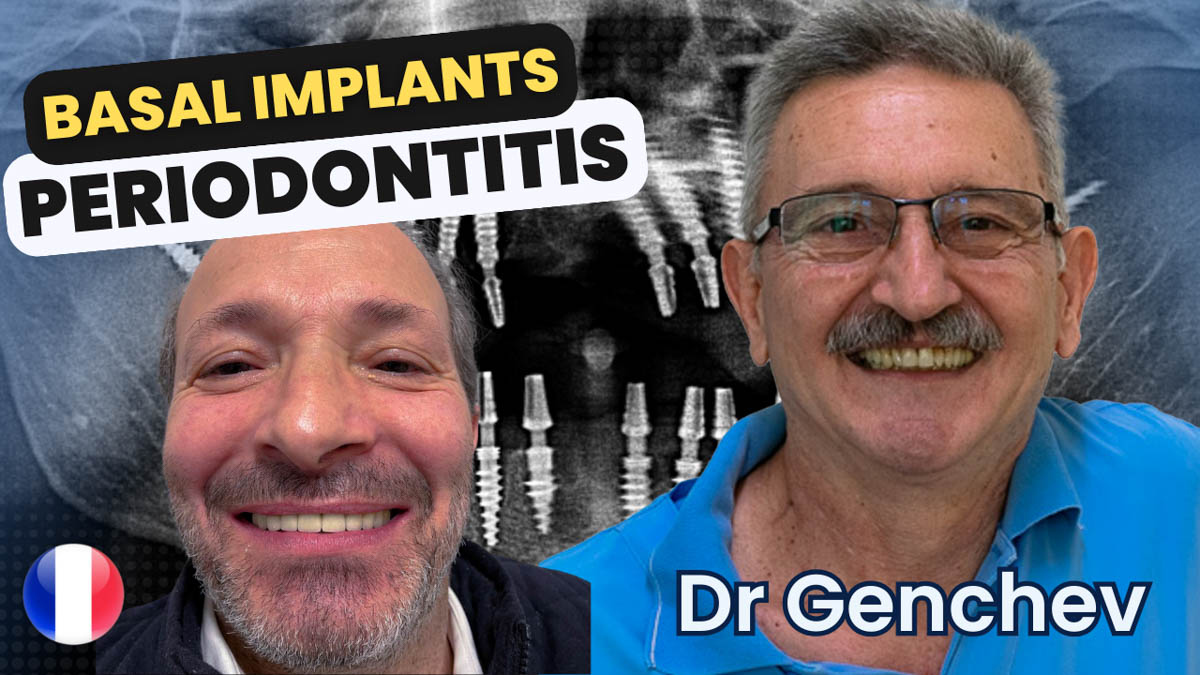
Dr. Genchev placed 25 basal dental implants, two permanent metal-ceramic bridges, and recreated Marc’s smile when he was a younger man, in one single 5-day visit in Plovdiv Bulgaria.
-
Failed All-on-6 Saved with Basal Implants
Dr Genchev saved Françoise after she suffered a failed All-on-6 procedure. Full dental restoration with basal dental implants in 5 days treating prognathism for €9,990.
-
Dr Genchev Dental Restoration for Gum Disease
Dr. Genchev transformed Véronique’s life in just 5 days with basal implants, restoring her ability to eat without pain and giving her back a confident smile.

All this information is provided solely as educational content. It is not medical advice. Our aim is to clarify the terminology and concepts relating to implantology and dental restoration with basal dental implants. For professional dental advice please consult multiple qualified implant dentists and compare their answers.