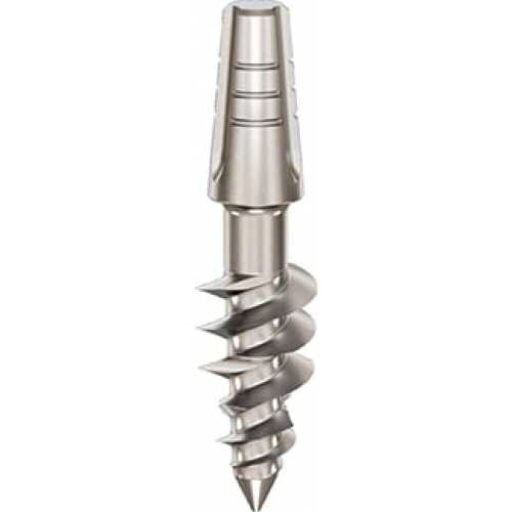
Treatments with basal dental implants give patients a full, fixed set of teeth in situations where conventional implants have been ruled out. That includes advanced gum disease, years of tooth loss with severe bone atrophy, diabetes and smoking. The reason is simple. Basal implants anchor in the hard cortical bone of the jaw, not in the soft gum bone that these conditions damage. No bone graft. No sinus lift. Most patients walk out with a fixed bridge after a single visit of 3 to 5 days.
Basal Implants Versus Conventional Implants
What is actually different about a basal implant?
Conventional implants are short and sit in the cancellous bone, the soft spongy layer just under the gums. That layer is exactly what gum disease, tooth loss, diabetes and smoking damage. It can resorb completely within 18 months of losing a tooth. Once it goes, a conventional implant has nothing solid to hold onto.
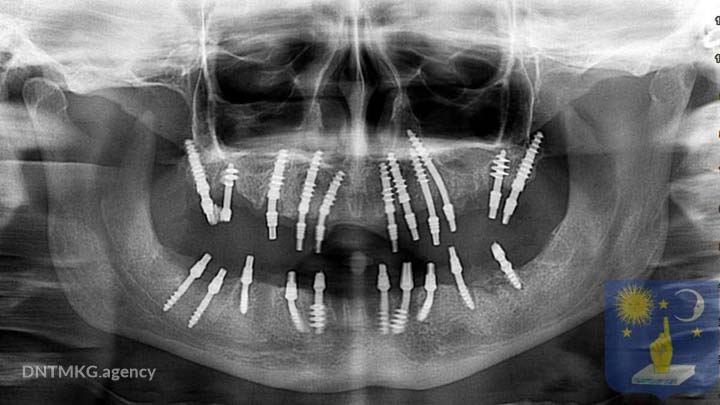
Basal dental implants are longer and one-piece. They pass through the soft layer and lock into the cortical bone underneath, which is dense and does not recede with tooth loss. Stability comes from mechanical anchorage in hard bone, so the implant carries load straight away. A basal case usually places 8 to 12 implants per jaw instead of 4 to 6, including tubero-pterygoid implants behind the sinuses to bring back the molars. Everything is splinted under one fixed bridge of 12 to 14 crowns.
Treatment for Advanced Periodontitis
Can I have implants placed if my gums are still infected?
Yes. Periodontitis attacks the gum tissue and the soft bone around the tooth roots. Teeth loosen, then they fall out. Conventional implants need that disease brought under control first, because they depend on the same bone the infection is destroying. Basal implants sit below the diseased layer, so active gum disease is far less of an obstacle.
The treatment is direct. Unstable teeth are extracted. Stable healthy teeth can often be kept and filed to help support the bridge. Implants go into the cortical bone along the whole arch. Then every implant and every retained tooth is blocked together under one full bridge. That blocking effect stops the remaining teeth from moving and helps bone regenerate around their roots. Removing the infected teeth also lets the gums heal. Read more about basal implant treatment for gum disease.
Treatment for Edentulism with Severe Bone Atrophy
I have been without teeth for years. Is it too late for me?
It usually is not. Missing teeth cause the gums to recede and the soft cancellous bone to shrink in height and density. This is bone atrophy. After a few years there is often too little of it left for conventional implants, which is why patients are told they need bone grafting or a sinus lift first.
Basal implants skip that step. The cortical bone is still there, and that is where the implant anchors. Implants are placed along the full length of the jaw, roughly 10 in the upper and 8 in the lower, so the bridge is supported evenly and the back teeth come back too. Grafting matters here because it fails often in atrophied bone, and each attempt costs months. Dr Genchev treated a 🇫🇷 French patient in 🇧🇬 Bulgaria who had already been through three failed grafts in three countries. He was restored with 18 basal implants in 5 days. See the full treatment for missing teeth and bone loss.
Treatment for Patients with Diabetes
Will my diabetes stop me from getting implants?
Diabetes slows healing and reduces circulation. Conventional implants depend on osseointegration in soft bone, and that process needs good blood supply. This is why many conventional implantologists refuse diabetic patients outright. The failure rate is too high to promise a result.
Basal implants change the equation. Cortical bone has a different structure and blood supply, and the implant gets its stability mechanically rather than waiting for soft tissue to heal around it. Diabetic patients can be treated as long as the diabetes is controlled, with insulin or medication such as Metformin. Healing is still slower and gum inflammation is more likely, so blood sugar management during recovery matters. See the full page on dental implants for diabetic patients.
Treatment for Smokers
Do I have to quit before I can be treated?
Quitting helps, and stopping around the surgery is strongly preferable. But smoking does not rule you out. The heat from cigarettes and e-cigarettes damages the soft gum tissue, and nicotine narrows blood vessels and slows healing. Both effects hit the exact tissue conventional implants rely on. Smokers are also more prone to periodontitis, and it progresses faster.
Basal implants avoid that mechanism entirely. The cortical bone they anchor in is not reached by cigarette heat and does not resorb with gum recession. Spreading the load across 8 to 12 implants adds a further safety margin. A large share of basal implant patients are current or former smokers. Read more about dental implants for smokers.
Basal Implants Compared to Conventional Implants
| Basal implants | Conventional implants | |
|---|---|---|
| Bone used | Hard cortical bone | Soft cancellous bone |
| Active periodontitis | Can be treated | Disease must be controlled first |
| Severe bone atrophy | No graft needed | Bone graft and sinus lift usually required |
| Diabetic patients | Treated when diabetes is controlled | Often refused |
| Smokers | Treated | Often refused |
| Implants per jaw | 8 to 12, including behind the sinuses | 4 to 6, front of the jaw only |
| Molars restored | Yes, with pterygoid implants | Rarely |
| Loading | Immediate, fixed bridge in 3 to 5 days | 3 to 6 months of healing first |
| Total timeline | One visit | 8 to 12 months |
FAQ Questions About Basal Dental Implant treatments
Can basal implants be placed if I have active gum disease?
Yes. Basal implants anchor in the cortical bone, which is far less affected by the inflammation of periodontitis. Conventional implants need the disease controlled first because they sit in the bone the infection is attacking. Extracting the unhealthy teeth and replacing them with basal implants also helps the gums heal.
Are basal implants more successful than conventional implants for diabetic patients?
Yes. Because they anchor in dense cortical bone rather than soft cancellous bone, basal implants do not depend as heavily on the slower healing diabetes causes. Studies show higher success rates for basal implants in diabetic patients. The diabetes still needs to be under medical control before treatment.
Basal dental implants are the best solution to treat gum disease and missing teeth with severe bone loss. It is also the best solution to treat the effects of bruxism. And basal implants are recommended patients who smoke as well as suffer from diabetes.
Basal Dental implants
for Bone Loss
Basal dental implants were designed to treat patients who suffer from severe bone atrophy. Basal implants are fixed into the hard cortical bone of the jaw to achieve stability for the bridge.

Basal Dental implants
for missing teeth
Basal dental implants are especially designed for patients who have missing teeth with severe bone loss. Basal implants help recreate the natural functionality of the mouth to give the patient a full set of fixed teeth.
Basal implants for
gum disease
Basal dental implants are the best solution to treat periodontal disease because they do not depend on the soft cancellous bone that recedes. They are fixed into the cortical bone that is deeper than the receding gums.

Basal dental implants
for bruxism
Basal dental implants are the best solution for patients who suffer from bruxism. Basal implants resist the grinding of the teeth that is associated with bruxism because they are fixed deep into the hard cortical bone.