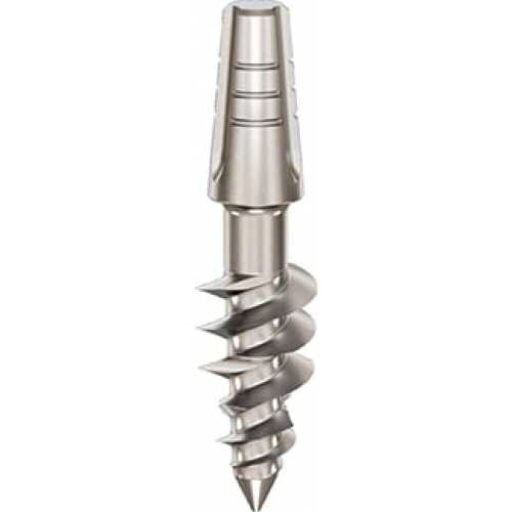
KOS ROOT is a single-piece immediate-loading dental implant system manufactured by Ihde Dental. It is designed as a compression screw implant and is used for fixed prosthetic restorations such as crowns, bridges and bars.
The implant has a straight single-piece body with an integrated prosthetic head for cementation. This design removes the need for a separate abutment screw, reduces the risk of screw loosening and simplifies the prosthetic workflow.
KOS ROOT implants are intended for immediate loading. According to the manufacturer, the prosthesis can be incorporated within a maximum of three days when the clinical conditions and primary stability are suitable.
The implant is made from a highly resistant titanium alloy and uses the No-Itis laser surface. This surface is designed to support osseointegration while reducing bacterial adhesion at the micrometric level.
The KOS ROOT Range
The KOS ROOT series offers a wide range of implant dimensions.
The full manufacturer range extends from 3.0 to 5.5 mm in diameter and from 6 to 20 mm in length.
The narrower diameters, especially 3.0 and 3.5 mm, are useful in thin ridges where horizontal bone width is limited. Wider diameters, such as 4.5, 5.0 and 5.5 mm, may be selected where the bone volume allows greater implant diameter.
For KOS ROOT implants with diameters from 3.0 to 4.0 mm, the stated maximum insertion torque is 50 Ncm. For diameters from 4.5 to 5.5 mm, the stated maximum insertion torque is 80 Ncm.
Anatomical Location for KOS ROOT Implants
KOS ROOT implants are used in zones where cancellous bone is present and can be compressed to generate primary stability.
They may be used for:
- Fixed bridges
- Full-arch restorations
- Bar-supported restorations
- Immediate-loading treatment protocols
- Narrow alveolar ridges where 3.0 or 3.5 mm implants are appropriate
- Cancellous bone zones in the upper and lower jaw
- Selected atrophic cases when sufficient primary stability can be achieved
In full-mouth rehabilitation, KOS ROOT can be combined with other Ihde Dental implant systems. In Dr Genchev’s clinical protocol, KOS ROOT is selected for cancellous bone compression zones, while BCS implants are used for pure cortical anchorage zones and TPG Uno implants are used where both cancellous compression and cortical fixation are available.
Bone Conditions For KOS ROOT
KOS ROOT is particularly useful when cancellous bone is available and can be condensed around the implant body.
The implant is inserted into an osteotomy that is generally prepared narrower than the implant core diameter. This allows the compression thread to condense the surrounding bone during insertion and create high primary stability.
The drilling protocol must be adapted to the local bone quality:
- In soft maxillary bone, less drilling may be required.
- In well-mineralized mandibular bone, a wider or more progressive drilling sequence may be needed.
- In very hard bone, the implant may be inserted slightly deeper and then turned back half a rotation to reduce excessive compression.
This makes KOS ROOT especially relevant in clinical situations where the dentist needs to adapt the osteotomy to different bone densities rather than follow a fixed drill sequence for every patient.
Anchorage Strategy
The primary anchorage strategy of KOS ROOT is cancellous bone compression.
The compression thread condenses the cancellous bone during insertion. This creates mechanical stability immediately after placement, which is essential for immediate loading.
In selected anatomical zones, KOS ROOT may also achieve additional cortical anchorage at the implant tip. This is not the same strategy as a purely cortical basal implant such as BCS, but it can provide an important second point of fixation when the anatomy allows it.
In Dr Genchev’s clinical case, KOS ROOT implants were used in two main anchorage patterns:
- Cancellous compression in the mandible and anterior maxilla The implant body compressed the cancellous bone to create primary stability.
- Compression with additional cortical anchorage In the posterior mandible, implant tips were directed toward the mylohyoid line. In the anterior maxilla, implant tips were fixed into the cortical bone of the nasal floor.
This combination helped create enough stability to support an immediate-loading full-mouth restoration.
Immediate Loading Protocol
KOS ROOT is designed for immediate loading.
Immediate loading means that the prosthetic restoration is connected very soon after implant placement, usually within a few days, provided that primary stability is sufficient and the implants are rigidly splinted through the prosthesis.
In Dr Genchev’s clinical protocol, the implants were splinted immediately after surgery with a photopolymer material to reduce micromovements. The definitive PFM metal-ceramic bridges were then fitted within five days.
This immediate-loading approach depends on:
- Careful preoperative planning
- Correct implant selection for each bone zone
- High primary stability
- Rigid splinting of implants
- Controlled occlusion
- Proper distribution of implants across the jaw
KOS ROOT contributes to this protocol by creating primary stability through compression in cancellous bone.
Clinical Case Study: How Dr Genchev Used KOS ROOT in a Full-Mouth Restoration
Marie was totally edentulous and had severe bilateral bone atrophy. Dr Genchev planned her treatment using a high-quality 2D OPG panoramic X-ray, assessing the height, width and density of the available bone in each area of both jaws.
The treatment involved 22 immediate-loading implants from three Ihde Dental systems:
- BCS implants for zones with hard cortical bone and little or no cancellous bone
- TPG Uno implants for zones with both cancellous and cortical bone
- KOS ROOT implants for cancellous bone compression zones, with optional cortical anchorage where anatomy allowed
After placing all 22 implants, Dr Genchev splinted them with photopolymer to reduce micromovement during the early healing phase. The prosthetic team then fabricated permanent PFM metal-ceramic bridges with 14 crowns per jaw.
The final bridges were designed to correct Marie’s reverse bite by adapting crown dimensions, inclination and occlusal contact points. Despite severe bone atrophy, the treatment was completed without bone grafting, without sinus lift and without zygomatic implants.
Marie received a fixed full-mouth restoration within five days.
Case Studies For KOS ROOT Ihde Dental Implants
-
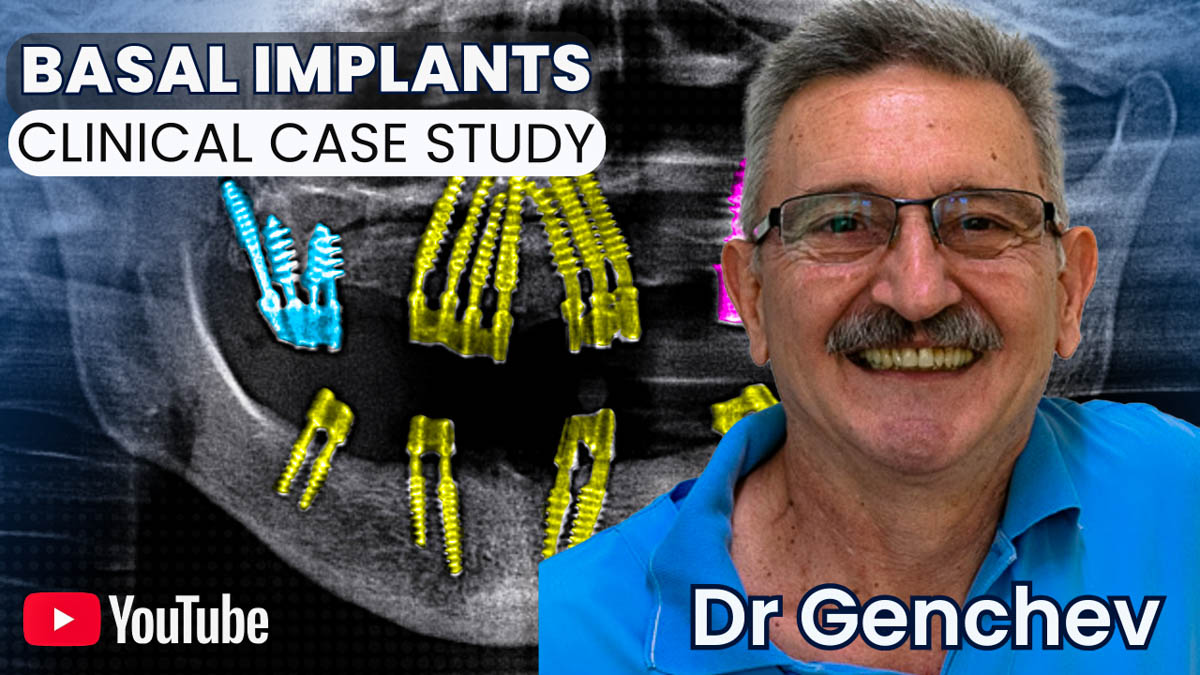
Basal Implants for Edentulism and Bone Atrophy
Clinical case study of Dr Genchev’s basal implant protocol for total edentulism and severe bone atrophy
-
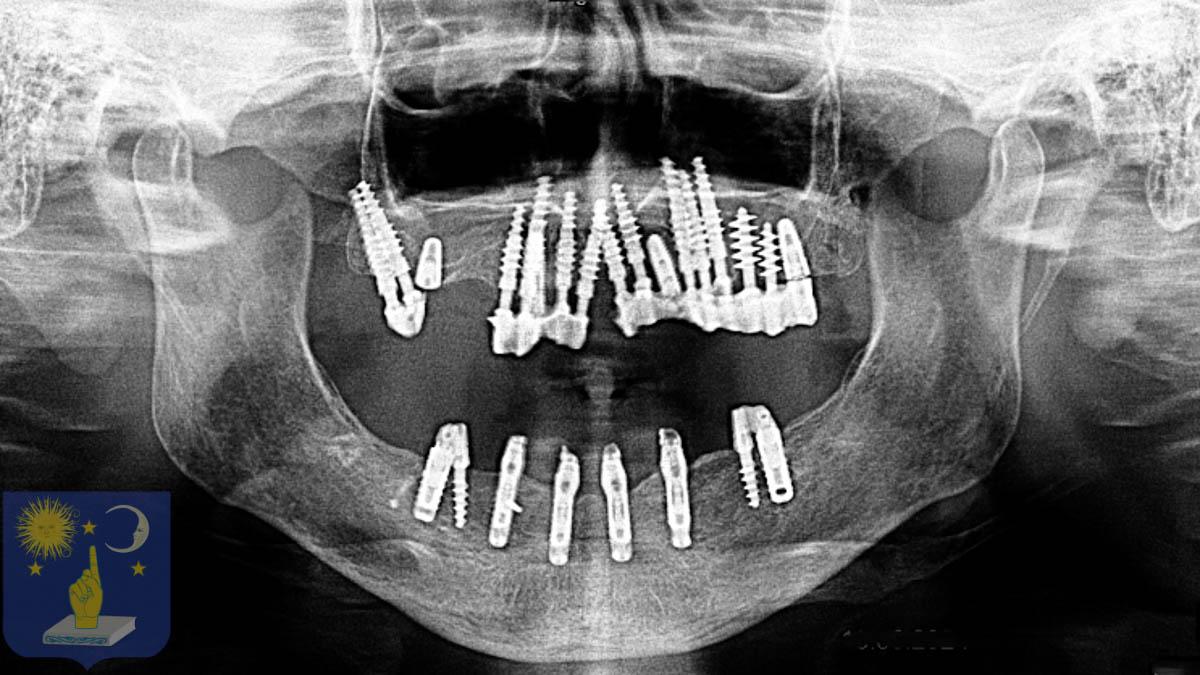
Failed All-on-6 Saved with Basal Implants
Dr Genchev saved Françoise after she suffered a failed All-on-6 procedure. Full dental restoration with basal dental implants in 5 days treating prognathism for €9,990.
-
Dr Genchev Bone Atrophy Treatment with Basal Implants
Dr Genchev in Bulgaria successfully rehabilitates with basal implants Paul’s maxillary who suffered from severe bone atrophy and had experienced 3 failed bone grafts. Full dental restoration in 5 days for €6,500. Real case study showing why basal implants succeed where conventional implants fail.
-
Dr Genchev Dental Restoration for Gum Disease
Dr. Genchev transformed Véronique’s life in just 5 days with basal implants, restoring her ability to eat without pain and giving her back a confident smile.