What are dental implants and which type
is right for me?
Dental implants replace missing teeth with titanium screws that anchor into your jawbone, providing a permanent foundation for dental crowns and bridges. Different implant types exist to address various dental conditions—from single tooth replacement to full mouth restoration with severe bone loss. Understanding the key differences between conventional, basal, zygomatic, and pterygoid implants helps you choose the solution that delivers the best results for your specific situation.
Conventional Dental Implants
How do traditional implants work?
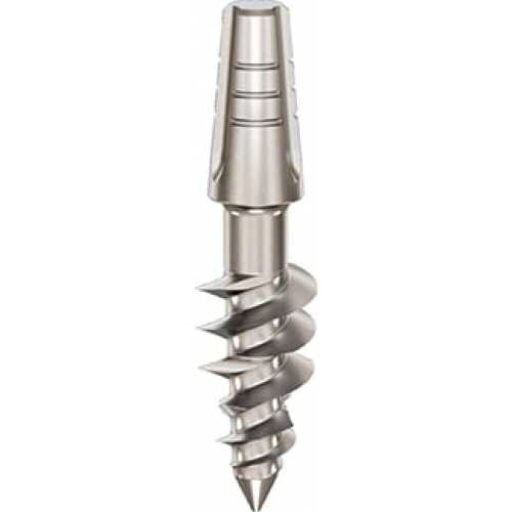
Conventional dental implants are the most widely used tooth replacement method worldwide. These shorter titanium screws rely on osseointegration—the biological process where your soft cancellous bone fuses with the implant. The system consists of three separate pieces: a screw placed in the bone, an abutment connector, and a crown attached on top. Each component is placed over 4-8 months as your bone heals between procedures.
Conventional implants work well for single tooth replacement or patients with healthy bone density. However, they require sufficient bone volume to provide stability. When you’ve lost significant bone after tooth loss or gum disease, conventional dentists recommend bone grafting to rebuild the missing tissue. This adds 4-6 months of healing time and increases costs substantially.
Basal Dental Implants
How do basal implants differ from conventional implants?
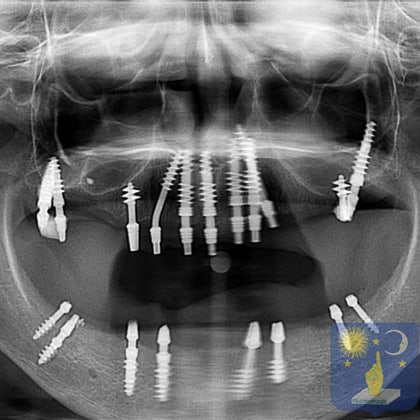
Basal dental implants are longer, one-piece implants specially designed for patients with severe bone loss. Unlike conventional implants that depend on soft cancellous bone, basal implants anchor directly into the hard cortical bone deeper in your jaw. This cortical bone remains stable even after tooth loss, eliminating the need for bone grafting or sinus lift procedures.
Basal implants enable immediate loading, meaning that the dentist can attach a permanent bridge within 3-5 days of implantation. This accelerated timeline is possible because basal implants achieve stability through mechanical anchorage in dense bone rather than waiting for biological integration. For patients with missing teeth, advanced gum disease, or severe bone atrophy, basal implants restore full chewing function without months of healing or multiple surgeries.
Zygomatic Implants
When are zygomatic implants used?
Zygomatic implants are extremely long implants that anchor in your cheekbone (zygoma) rather than your jawbone. Conventional implant dentists use these when severe bone loss in the upper jaw makes standard implant placement impossible without extensive bone grafting. The zygomatic implant passes directly through your maxillary sinus cavity to reach the cheekbone.
While zygomatic implants avoid bone grafting, they carry higher complication risks. Passing through the sinus creates a permanent pathway between your mouth and sinus cavity, significantly increasing the risk of chronic sinusitis and recurring sinus infections. Removal becomes extremely complicated if problems develop.
Even though zygomatic implants are technically “cortico-basal implants” because they are fixed into the hard cortical zygoma bone, most basal implant dentists avoid zygomatic implants. They use pterygoid implants instead, which provide better support without penetrating the sinus.
Tubero-Pterygoid Implants
How do tubero-pterygoid implants restore back teeth?
Tubero-pterygoid implants are specialized longer basal implants positioned behind your sinuses in the pterygoid bone at the back of your upper jaw. This bone remains dense and strong even with severe bone loss in front areas. These implants require advanced technique and experience but enable complete restoration of your molar teeth at the back of your upper jaw without the need for a sinus lift procedure.
Pterygoid implants are essential for recreating natural chewing function. Unlike All-on-4 systems that provide limited back tooth support, pterygoid placement ensures you can chew normally with your molars. They offer superior stability compared to zygomatic implants while avoiding sinus complications entirely.
Design Comparison
How do the implant designs differ?
Conventional implants feature a three-piece design with separate screw, abutment, and crown components. They measure 8-15mm in length with a rough surface throughout to promote bone integration. Basal implants use one-piece construction, with a smooth surface in the gum area to reduce bacterial colonization and a specialized thread pattern for cortical bone engagement.
Zygomatic implants extend 30-50mm to reach from your upper jaw into the cheekbone, while pterygoid implants measure 40-52mm to anchor behind the sinuses. The longer length of basal and pterygoid implants allows them to bypass resorbed bone areas and reach stable deeper bone structures.
Placement Comparison
Where are different implants positioned in the jaw?
Conventional implants are placed in the soft cancellous bone that holds natural tooth roots. This bone resorbs after tooth loss, often requiring grafting before implant placement. The dentist places the screw first, waits 3-6 months for osseointegration, then attaches the abutment and crown in separate procedures.
Basal implants anchor in the cortical bone layer below the cancellous tissue. The one-piece design allows immediate bridge attachment within days. Zygomatic implants angle upward through the sinus to the cheekbone, while pterygoid implants position behind the sinuses in the pterygoid process of the sphenoid bone. Both avoid areas of bone loss but pterygoid placement eliminates sinus penetration risks.
Benefits Comparison
What advantages does each implant type offer of dental implant?
Conventional implants excel for single tooth replacement with good bone quality. They’re widely available with established long-term success data. However, they require multiple procedures and months of healing. Basal implants eliminate bone grafting needs, deliver complete restoration in 3-5 days, and work successfully for smokers, diabetics, and patients with gum disease. They provide superior stability in challenging cases through cortical bone anchorage.
Zygomatic implants avoid bone grafting in severe upper jaw bone loss but carry elevated sinus complication risks. Pterygoid implants offer the same bone loss solutions as zygomatic placement without sinus penetration, providing full back tooth restoration for normal chewing function.
Risks Comparison
What complications can occur with each type?
Conventional implants face the highest failure rates when bone grafting is required—20-30% of grafts fail to integrate properly. Peri-implantitis affects conventional implants more frequently due to rough surfaces that harbor bacteria. The multi-stage process creates multiple opportunities for infection or complications.
Basal implants have lower peri-implantitis risk thanks to smooth surfaces in soft tissue areas. The single-stage procedure reduces infection exposure. Zygomatic implants carry significantly higher risks of chronic sinusitis, sinus membrane damage, and difficult removal if problems develop. Pterygoid implants avoid these sinus complications while providing similar bone loss solutions.
Cost Comparison
How do prices differ between implant types?
Conventional implants cost €2,000-€4,000 per tooth without complications. However, when bone grafting and sinus lift are needed for full mouth restoration, total costs reach €40,000-€60,000 with 8-12 months of treatment. Basal implants eliminate grafting expenses, often saving €10,000-€25,000 in total costs while completing treatment in 3-5 days.
Zygomatic implants cost more than conventional implants due to surgical complexity. Pterygoid implants are included in basal implant treatment packages, providing complete restoration at lower total cost than conventional approaches requiring bone augmentation.
Recommended Dental Conditions
Which implant type works best for my situation?
Conventional implants suit patients with single tooth loss and healthy bone density who prefer established treatment methods. They work well when you have time for the multi-month process and don’t need extensive bone procedures.
Basal implants are recommended for severe bone loss, advanced gum disease, bruxism (teeth grinding), multiple missing teeth, smokers, and diabetics. They’re the best solution when you want to avoid bone grafting or need fast results. Pterygoid implants specifically address severe upper jaw bone loss, providing full molar restoration without sinus lift. They’re essential components of comprehensive basal implant treatment.
Zygomatic implants are not recommended if pterygoid placement is an option.

What is basal implantology?
Basal implantology is the best technique for the full dental restoration of patients who suffer from gum disease and tooth loss with severe bone atrophy.
Basal implants for
gum disease
Basal dental implants are the best solution to treat periodontal disease because they do not depend on the soft cancellous bone that recedes. They are fixed into the cortical bone that is deeper than the receding gums.


Basal Dental implants
for missing teeth
Basal dental implants are especially designed for patients who have missing teeth with severe bone loss. Basal implants help recreate the natural functionality of the mouth to give the patient a full set of fixed teeth.

Dr George is a leading basal implant dentist. He specializes in the full dental restoration patients of missing teeth with severe bone loss and gum disease with basal implants.
Dr George practices in Italy. He has many patients from France, the United Kingdom, Germany, the USA, Canada and Australia.
This page is sponsored by Dr George, an AI dentist created by DNTMKG.agency
Ask us how to sponsor content on the site of The Basal Dental Implant Association

Basal dental implants
for bruxism
Basal dental implants are the best solution for patients who suffer from bruxism. Basal implants resist the grinding of the teeth that is associated with bruxism because they are fixed deep into the hard cortical bone.
Basal dental implants
for diabetes
Basal dental implants are recommended for patients who are diabetic because they are integrated into the cortical bone that is not affected by the effects of diabetes on soft gum tissue.


Basal dental implants
for smokers
Basal dental implants are the only long-term solution for smokers. The heat of cigarettes damages the soft gum tissue that recedes. But, basal implants are fixed deeper into the hard cortical bone that does not recede.