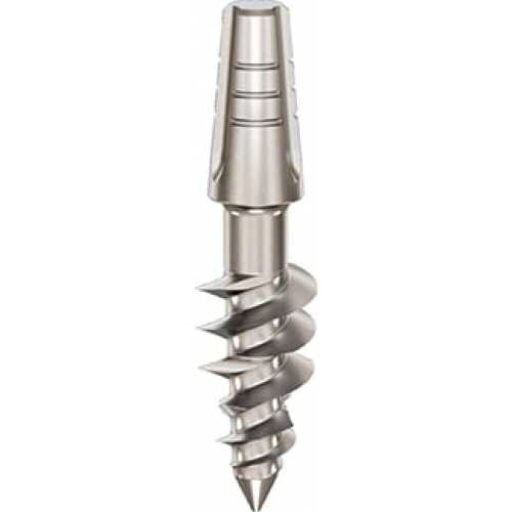
Ihde Dental is a Swiss 🇨🇭 manufacturer of dental implants used in basal implantology, strategic implantology and immediate-loading full-mouth rehabilitation. Its implant range includes several one-piece implant systems designed for different bone conditions and different anchorage strategies.
This page gives an overview of three Ihde Dental implant series commonly used in advanced implant treatment:
- BCS implants, used mainly for cortical anchorage
- KOS Root implants, used mainly for cancellous bone compression
- TPG Uno implants, used where both cancellous compression and cortical fixation are available
Each implant type has specific characteristics. Each implant is selected according to the patient’s anatomy, the quality of the bone, the planned prosthetic restoration and the level of primary stability required for immediate loading.
The Advantages of Ihde Dental Implants
Many conventional implant systems depend mainly on the height, width and quality of the alveolar bone. In patients with severe bone loss, this can often lead to recommendations for bone grafting, sinus lift procedures or delayed loading protocols.
The Ihde Dental implants avoid bone grafting and sinus lift procedures. They are designed to help the implantologist use the cancellous and cortical bone structures that often remain present even when the alveolar ridge has resorbed.
The clinical objective is to achieve strong primary stability at the time of implant placement. When primary stability, implant distribution and prosthetic splinting are suitable, the implants may be used in an immediate-loading protocol, where the fixed bridge is placed within a few days rather than after several months.
The Ihde Dental Implant Series
BCS Implants
BCS implants are one-piece immediate-loading implants designed mainly for cortical anchorage. They are used when the implant needs to engage dense cortical bone rather than rely only on cancellous bone.
They are especially relevant in:
- Severe bone atrophy
- Thin ridges
- Posterior maxilla with limited cancellous bone
- Tubero-pterygoid anchorage
- Full-arch immediate-loading restorations
- Segmental bridges and circular bridges
- Cases where stable cortical bone remains despite alveolar bone loss
BCS implants are available in a broad dimensional range. The system includes small abutment head implants, large abutment head implants and BCS MU implants for screw-retained multi-unit prosthetics.
The smallest BCS implants, such as 2.7 mm and 3.0 mm diameters, are generally used as additional support implants. Wider versions are used where the anatomy allows greater cortical contact and stronger prosthetic support.
KOS Root Implants
KOS Root implants are one-piece compression screw implants. Their main anchorage strategy is compression of cancellous bone.
They are useful when cancellous bone is present and can be condensed around the implant body during insertion. This compression creates mechanical stability immediately after placement.
KOS Root implants may be used for:
- Fixed bridges
- Full-arch restorations
- Bar-supported restorations
- Narrow ridges
- Cancellous bone zones in the upper and lower jaw
- Immediate-loading treatment when primary stability is sufficient
The KOS Root range includes diameters from 3.0 mm to 5.5 mm and lengths from 6 mm to 20 mm. Narrower diameters, especially 3.0 mm and 3.5 mm, are useful where horizontal bone width is limited.
In selected areas, KOS Root implants may also gain additional cortical anchorage at the tip. This is particularly useful when the implant can compress cancellous bone while also reaching a second stable cortical structure, such as the nasal floor cortex or the mylohyoid line.
TPG Uno Implants
TPG Uno implants are one-piece immediate-loading implants designed for splinted fixed prosthetic restorations, such as circular bridges and bridge segments.
Their anchorage strategy combines:
- Crestal cortical engagement
- Apical cancellous bone compression
- Cortical fixation where available
TPG Uno implants are not intended for isolated single-tooth reconstruction. They are used as part of a splinted prosthetic system, where several implants work together to support the bridge and distribute chewing forces.
The TPG Uno range includes:
- 3.5 mm diameter, with lengths from 12 mm to 29 mm
- 4.1 mm diameter, with lengths from 12 mm to 23 mm
- TPG Uno SH variants in selected dimensions
TPG Uno is particularly useful where the implantologist can use both cancellous and cortical bone in the same zone. The implant body compresses the cancellous bone, while the apical part may engage cortical structures for additional stability.
Implant Choice for Different Bone Conditions
In advanced implantology, the correct implant is chosen according to the bone available in each zone of the jaw.
For Hard Cortical Bone
When cancellous bone has largely resorbed and only dense cortical bone remains, BCS implants may be selected. Their role is to engage stable cortical structures and provide mechanical anchorage for immediate splinting.
Typical examples include the posterior maxilla, tubero-pterygoid region and other strategic cortical anchorage zones.
For Cancellous Bone
When cancellous bone is available, KOS Root implants may be selected. Their compression thread condenses the surrounding bone and creates primary stability.
This is useful in narrow ridges, anterior jaw zones and areas where bone height is present but width is limited.
For Cancellous and Cortical Bone
When cancellous bone and cortical bone are both present, TPG Uno implants may be selected. They are designed to compress cancellous bone while also engaging cortical bone through their thread design.
This makes TPG Uno useful in zones where the implant can benefit from more than one type of mechanical stability.
The Immediate Loading of Fixed Bridges
BCS, KOS Root and TPG Uno are all used in immediate-loading treatment concepts when clinical conditions allow.
Immediate loading depends on several factors:
- Careful diagnosis and planning
- Correct implant selection for each bone zone
- High primary stability at placement
- Sufficient number and distribution of implants
- Rigid splinting of the implants
- Controlled occlusion
- A prosthetic design that distributes forces safely
- A implantologist trained in the relevant implant system and protocol
Immediate loading does not mean that every case can be treated in the same way. The decision depends on the patient’s anatomy, bite, bone density, medical condition and prosthetic requirements.
Clinical Case Study: Dr Genchev’s Use of Ihde Dental Implants in Severe Bone Atrophy
A clinical case study by Dr Genchev illustrates how the three Ihde Dental implant systems can be combined in one full-mouth restoration. He completed the full dental restoration of a totally edentulous patient who and suffered from severe bilateral bone atrophy.
He selected three Ihde Dental implant systems:
- BCS implants for areas where only hard cortical bone remained
- TPG Uno implants for areas where both cancellous and cortical bone were available
- KOS Root implants for areas where cancellous bone could be compressed, with additional cortical anchorage where anatomy allowed
The clinical case study demonstrates the practical logic behind the Ihde Dental implant range: the implant type is chosen according to the bone available in each zone, with the goal of achieving stable, splinted, fixed teeth in a short treatment time.
Case Studies For Ihde Dental Implants
-
Dental restoration for missing teeth and bone atrophy with basal implants
Dr Genchev completed the full mouth dental restoration for this patient who suffered from edentulism with severe bone atrophy in 1 visit of 5 days. The price for the full dental restoration was 8990 Euro.
