The mylohyoid line is a bony ridge on the medial (inner, lingual) surface of the mandibular body. It runs obliquely from the posterior molar area downward and forward toward the midline. It is named after the mylohyoid muscle, which attaches along this ridge and forms the muscular floor of the mouth.
The mylohyoid line (Latin: linea mylohyoidea) is a cortical ridge that runs along the inner surface of the mandible. It is one of the most clinically important anatomical structures in lower jaw implant planning because it stays dense and mineralized even when the rest of the alveolar ridge has resorbed. For patients with posterior mandibular bone loss, it can be the difference between having implants and being told there is not enough bone.
In anatomical terms:
- Location: Medial surface of the mandibular body, running diagonally from the third molar area to the symphysis region.
- Synonyms and alternative names: Mylohyoid ridge, internal oblique line (Latin: linea obliqua interna), medial oblique ridge.
- Function: Attachment site for the mylohyoid muscle, which elevates the floor of the mouth during swallowing and speech.
The mylohyoid line is not at the top of the alveolar ridge. It runs obliquely on the inner (lingual) side of the mandibular body, below the alveolar crest. This matters for implant planning because the bone along this ridge is cortical and remains relatively stable even in patients with extensive alveolar resorption.
The Bone Quality of the Mylohyoid Line for Implantation
Is the bone at the mylohyoid line good enough for implant anchorage?
The mylohyoid line is cortical bone. It does not follow the same resorption pattern as the softer cancellous alveolar bone above it. In patients with significant mandibular bone loss, particularly in the posterior mandible where the alveolar ridge may be very narrow or reduced in height, the mylohyoid line can persist as a dense, reliable cortical structure.
In terms of bone type classification, the mylohyoid line is most appropriately associated with D1 or D2 bone characteristics. It is compact, well-mineralized cortical bone rather than the softer trabecular bone that conventional implants rely on.
This is precisely what makes it valuable in strategic implantology. When the overlying alveolar ridge is insufficient for a conventional implant, the mylohyoid line represents a cortical anchorage target that is still present and still reliable. The implant does not need to be placed purely in the reduced alveolar bone. With the right angulation, it can reach the mylohyoid line on the lingual cortex.
The Mylohyoid Line for Strategic Implantation
What does my dentist need to know about the mylohyoid line before placing posterior mandibular implants?
The mylohyoid line changes the surgical approach for posterior mandibular implants in patients with limited bone height or width.
In the posterior lower jaw, the inferior alveolar nerve runs inside the mandibular canal. This limits how far below the alveolar crest an implant can go in the conventional vertical direction. When bone height is limited and a vertically placed implant cannot safely avoid the nerve, an alternative approach is needed.
By inclining the implant lingually (toward the inner side of the jaw), the surgeon can direct the implant tip past the nerve canal and anchor it into the mylohyoid line on the medial cortical surface. This technique requires:
- CBCT planning to identify the exact position of the nerve canal and the mylohyoid line in three dimensions.
- Controlled lingual inclination during drilling and insertion, usually managed at slow speed to allow tactile feedback.
- Appropriate implant dimensions to reach the cortical ridge without perforation of the lingual cortex beyond the desired level.
This approach is not improvisational. It requires precise anatomical knowledge and careful presurgical analysis of each patient’s mandibular cross-section. But when it is executed correctly, it provides strong primary stability in a zone where conventional vertical implant placement would often fail or be contraindicated.
Implant Selection for Mylohyoid Line Anchorage
Which implants are best for using the mylohyoid line as an anchorage point?
Not all implants are suited to this technique. The choice depends on the available bone in the osteotomy path, the implant diameter the anatomy can accommodate, and the prosthetic plan.
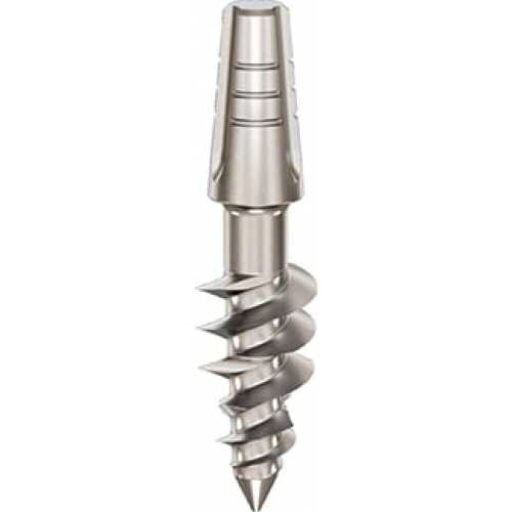
Ihde Dental KOS Root is a compression screw implant used extensively in mandibular cases by experienced basal implantologists. Its narrow diameters (3.0 and 3.5 mm) are particularly useful in the posterior mandible where bone width is limited. The compression thread condenses the cancellous bone during insertion, and when the implant tip is directed lingually at the mylohyoid line, it gains additional cortical anchorage there. This combination of cancellous compression and cortical tip fixation is one of the most clinically practical approaches for limited posterior mandibular bone.
Ihde Dental BCS is relevant when cancellous bone is absent and the anchorage must come from cortical structures only. In cases of severe posterior mandibular atrophy, BCS implants can be directed toward available cortical bone, including the lingual cortical plate and the mylohyoid ridge area.
BasalFix Compressive-Fix is suited to transition zones in the posterior mandible where some cancellous bone remains but the mylohyoid line is reachable at the tip. It combines lateral cancellous compression with cortical tip engagement, which maps directly onto the anatomical opportunity the mylohyoid line provides.
BasalFix Basal can be used in severe atrophy cases where dual cortical fixation is the primary goal. The implant tip engages the second cortical structure, in this case the lingual cortical plate at the mylohyoid line level.
Monoimplant Microthread is designed with a sharp tip for cortical penetration. Its design is intended to stabilize socket walls and create immediate fixation, which can be useful when the procedure involves the dense cortical structures of the mandibular inner surface.
The Mylohyoid Line and Implant Outcomes
Does using the mylohyoid line make my implants more reliable?
Using the mylohyoid line as an anchorage target can provide meaningful advantages in posterior mandibular implant planning for patients with bone loss.
Because this cortical ridge does not resorb at the same rate as the overlying alveolar bone, it offers a stable mechanical anchor even in jaws that have lost significant volume. This can make it possible to place implants in positions where conventional approaches would otherwise require bone grafting or would simply not be possible.
However, the technique demands accurate three-dimensional imaging, careful surgical planning and clinical experience. It is not a universal solution. Each patient’s anatomy is different, and the position, inclination and density of the mylohyoid line must be individually assessed before it can be used as a planned anchorage structure.
Case Studies About The Mylohyoid Line
-
Basal Implants for Edentulism and Bone Atrophy
Clinical case study of Dr Genchev’s basal implant protocol for total edentulism and severe bone atrophy

-
Dr Genchev Dental Restoration for Gum Disease
Dr. Genchev transformed Véronique’s life in just 5 days with basal implants, restoring her ability to eat without pain and giving her back a confident smile.

-
Dental restoration for missing teeth and bone atrophy with basal implants
Dr Genchev completed the full mouth dental restoration for this patient who suffered from edentulism with severe bone atrophy in 1 visit of 5 days. The price for the full dental restoration was 8990 Euro.
