The mandible, or lower jaw (Latin: mandibula), is the foundation for all lower-arch dental implantation. It is the only moveable bone of the skull and carries the lower teeth. For implant planning, it offers some of the most reliable bone in the entire mouth. But it also contains critical anatomical structures that demand careful planning before any implant is placed.
Understanding the mandible means understanding where the good bone is, where the risks are, and how different implant systems interact with its anatomy.
The mandible is the U-shaped bone that forms the lower jaw. In anatomy, it is divided into several zones that matter differently for implantology:
- The body of the mandible runs horizontally and houses the lower teeth in the alveolar process.
- The symphysis (Greek: symphysis menti) is the central midline area. It is one of the densest bone zones in the entire jaw.
- The parasymphysis refers to the area on either side of the symphysis, just lateral to the midline.
- The interforaminal region is the zone between the two mental foramina, the small openings through which the mental nerve exits on each side. This region is a key implant zone because the inferior alveolar nerve is safely below it.
- The mandibular body extends posteriorly toward the premolar and molar zones.
- The ramus is the vertical part that rises to form the temporomandibular joint (TMJ).
The alveolar process (Latin: processus alveolaris) is the tooth-bearing ridge. This is the part that resorbs after tooth loss. But the basal bone underneath it, including the cortical plates, is far more stable.
The Bone Quality of the Mandible
Is the bone in my lower jaw strong enough for implants?
The mandible generally has the best bone quality in the entire dentition. The anterior mandible in particular is associated with D1 and D2 bone types in the Misch classification.
D1 bone is very dense cortical bone with limited trabecular component. It is most commonly associated with the mandibular symphysis and parasymphysis. The buccal (outer) and lingual (inner) cortical plates in this area are thick and dense. This is mechanically strong bone. The challenge is not achieving stability but avoiding overheating, over-compression and poor vascularization during surgery.
D2 bone is thick porous cortical bone with a healthy trabecular core. It is found widely across the mandibular body, including the premolar region. D2 bone offers one of the most favorable conditions for implant placement because it combines cortical strength with good vascularity.
In the posterior mandible, bone quality can vary. Some patients retain reasonable D2 bone there. Others show more resorption and softer conditions. In patients with severe bone loss or periodontal disease, the posterior mandible may have reduced height and width, which requires careful planning.
Crucially, the cortical plates of the mandible tend to remain relatively dense even when the alveolar ridge has resorbed. This is why basal implant techniques can often achieve excellent results in the lower jaw even years after tooth loss.
The Key Anatomical Structures for Strategic Implantation
What does my dentist need to look for before placing implants in my lower jaw?
Several anatomical structures in the mandible directly affect where and how implants can be placed.
The inferior alveolar nerve (Latin: nervus alveolaris inferior) runs through the mandibular canal inside the bone, from the mandibular foramen to the mental foramen. Implants placed in the posterior mandible must avoid this nerve. A CBCT scan is essential to map the nerve path before surgery.
The mental foramen (Latin: foramen mentale) is the exit point of the mental nerve on each side of the mandible. The interforaminal zone between the two foramina is the safest implant zone in the lower jaw and allows a wide range of implant lengths.
The mylohyoid line (Latin: linea mylohyoidea) is a cortical ridge that runs obliquely along the inner (lingual) surface of the mandible. It is the attachment site of the mylohyoid muscle. In terms of implantology, this ridge is clinically significant because it remains densely mineralized even when the alveolar ridge has substantially resorbed. It can serve as a cortical anchorage target for implants placed with a lingual inclination in the posterior mandible.
The lingual and buccal cortical plates together form the outer shell of the mandible. They are the main structural anchors for basal implants in the lower jaw.
Implant Selection for the Mandible
Which implants work best for the lower jaw?
Implant selection in the mandible depends on which zone is being treated and what bone remains.
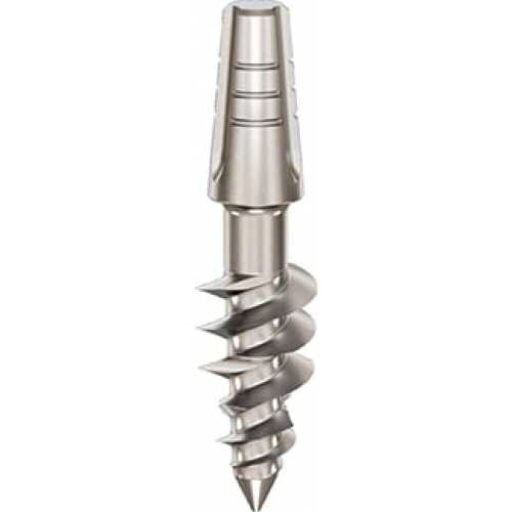
In the anterior mandible, where D1 and D2 bone are common, implants using cancellous compression are highly effective. The Ihde Dental KOS Root is a compression screw implant that condenses the cancellous bone during insertion to generate immediate primary stability. In the anterior interforaminal zone, KOS Root implants can also gain additional fixation at the tip if the implant length allows contact with the opposite cortical plate, a technique called bicortical fixation.
The Ihde Dental TPG Uno is also useful in the mandibular body where both cancellous and cortical bone are present. Its triple-thread design engages the crestal cortical bone, compresses cancellous bone and can anchor into deeper cortical structures.
When only cortical bone remains in atrophied mandibular zones, the Ihde Dental BCS provides pure cortical anchorage. Its role is to engage stable cortical structures and provide mechanical anchorage for immediate splinting.
The BasalFix Compressive is appropriate where healthy cancellous bone is present, particularly in the anterior mandible. The BasalFix Compressive-Fix extends this by also engaging the second cortical plate at the tip, combining compression with cortical anchorage. This is particularly useful in transition zones or where the mylohyoid line is reachable.
Monoimplant Smooth fixtures are designed for D1 and D2 bone, using sharp thread geometry to achieve strong mechanical engagement. Monoimplant Microthread variants can be useful when cortical penetration and socket wall support are part of the treatment plan.
Case Studies About The Mandible
-
Basal Implants for Edentulism and Bone Atrophy
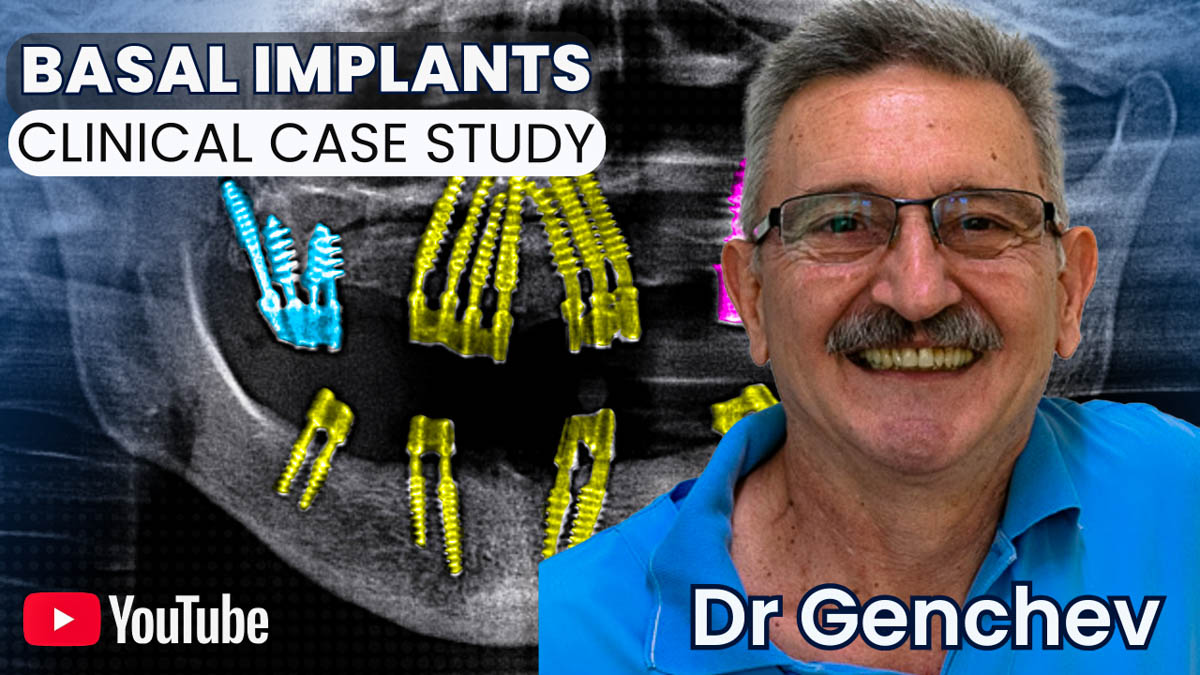
Clinical case study of Dr Genchev’s basal implant protocol for total edentulism and severe bone atrophy