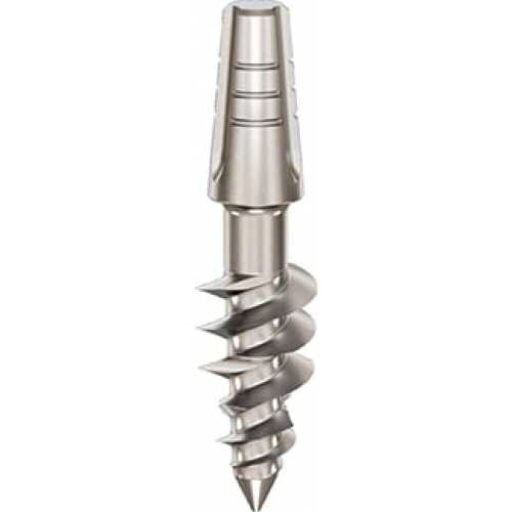
Monoimplant Dental Implants
Monoimplant is a Swiss 🇨🇭 dental implant manufacturer based in Switzerland. The central concept of the Monoimplant system is that the implant and abutment are integrated into a single structure. This one-piece design reduces the space required for a separate abutment connection and is intended to preserve more bone compared with wider two-piece implant connections. Monoimplant also emphasizes bicortical anchorage, where the implant is stabilized between two cortical bone layers: the entry cortical bone and the exit cortical bone. This principle is used to obtain high primary stability, which is essential when immediate loading is planned.
The Advantages of Monoimplant Dental Implants
Monoimplant implants are designed around three main clinical ideas:
- One-piece implant design The implant and abutment are manufactured as one continuous unit. This avoids a separate implant-abutment connection and may reduce the amount of bone needed around the coronal part of the implant.
- Bicortical fixation The implant is intended to engage cortical bone at both the entry and exit points. Cortical bone is denser and stronger than cancellous bone, and this can help provide strong primary stability.
- Immediate loading protocol The system aims to achieve high primary stability at placement, Monoimplant implants may be used in immediate-loading protocols when the clinical situation allows it. Immediate loading depends on implant distribution, bone quality, insertion stability, prosthetic splinting and careful control of occlusion.
Monoimplant Implant Series
The Monoimplant system includes several implant designs and surface types. The main groups described by the manufacturer are:
- Smooth Monoimplant
- Rough Monoimplant
- MOT Monoimplant
- Microthread Monoimplant
- Rough implants
- Rough-B implants
- Rough implants with large abutment
Each implant design has a specific role depending on the bone type, anatomical site and surgical objective.
Clinical Use of Monoimplant Implants
Monoimplant implants may be used in a range of implant rehabilitation situations, including:
- Single missing teeth
- Multiple missing teeth
- Extraction socket implant placement
- Healed ridge implant placement
- Full-arch rehabilitation
- Immediate-loading implant bridges
- Cases where bicortical fixation is possible
- Selected cases with reduced bone volume, depending on cortical anchorage
Because the system is based on one-piece implants, planning must consider the final prosthetic axis from the beginning. The implant position, emergence direction, occlusion and bridge design all need to be planned before surgery.
Immediate Loading with Monoimplant
Immediate loading means that a fixed prosthesis may be connected soon after implant placement, provided that the implants have sufficient stability.
For Monoimplant implants, immediate loading is linked to:
- Bicortical anchorage
- One-piece implant design
- Strong primary stability
- Adequate number of implants
- Proper distribution across the arch
- Rigid prosthetic splinting
- Careful occlusal control
Immediate loading is not automatic. It must be confirmed clinically at the time of surgery and must be adapted to the patient’s bone quality, anatomy and bite forces.
Smooth Monoimplant
Smooth Monoimplant fixtures have a smooth surface and sharp aggressive thread geometry. They are best used in hard bone types, namely D1 and D2. But, they can also be useful for immediate fixation, including extraction sockets and softer D3 and D4 bone situations.
In practical clinical terms, the smooth surface may be useful where reduced bacterial colonization is desired, while the sharp thread is intended to create strong mechanical engagement.
Main features
- Smooth surface
- Sharp aggressive thread
- Designed to obtain strong primary stability
- Used in immediate-loading protocols when stability is sufficient
- May be considered in dense cortical bone and selected extraction socket situations
Bone types
- D1 and D2 bone in the indication section
- D3 and D4 bone optional
Rough Monoimplant
Rough Monoimplant have an RBM surface with calcium phosphate treatment. The rough surface is intended to encourage faster and stronger osseointegration by allowing bone to grow into and around the porous implant surface. Their rough surface and less aggressive thread are suitable when working in soft bone types such as D3 and D4
Main features
- RBM rough surface
- Calcium phosphate treatment
- Less aggressive thread design
- Designed to support osseointegration
- Available in several widths and lengths
Bone types
- D3 and D4 bone in the indication section
- D1 and D2 bone also mentioned in the descriptive section
Clinically, the rough surface is especially relevant where biological integration is important, while implant diameter and thread design must be selected according to bone density and available bone volume.
MOT Monoimplant
MOT Monoimplant is a hybrid design combining characteristics of both Rough and Smooth Monoimplant fixtures. The upper part is treated like the Rough type to stimulate osseointegration, while the apical tip is highly polished.
The polished tip is intended to reduce contamination risk, particularly in cases involving the maxillary sinus area. This makes MOT Monoimplant especially relevant when working close to the sinus, where reducing bacterial contamination is an important surgical consideration.
Main features
- Hybrid rough and smooth surface design
- Rough upper portion to encourage osseointegration
- Smooth polished apical tip
- Designed for selected maxillary sinus area cases
- Combines mechanical stability with surface-specific biological behavior
Bone types
- D3 and D4 bone types, due to the rough implant characteristics
- Selected sinus-related situations, due to the polished apical tip
Microthread Monoimplant
Microthread Monoimplant fixtures are smooth surface implants with a micro-thread design help reduce bacterial colonization and avoid peri-implant disease.
The sharp tip is designed to penetrate cortical bone easily, especially in thin and dense cortical areas. The cervical thread design is intended to stabilize extraction socket walls and help prevent collapse.
Clinical use
Microthread Monoimplant may be considered in cases where cortical penetration, socket wall support and immediate loading are part of the treatment plan.
Microthread Monoimplants are described as suitable for both healed sites and extraction sites. The manufacturer states that a minimum of three implants should be used for successful immediate loading.
Main features
- Smooth surface
- Micro-thread cervical design
- Sharp tip for cortical penetration
- Designed for primary stability
- Suitable for healed areas and extraction sites
- Intended for immediate loading when at least three implants are used and stability is sufficient
Rough Implant Product Range
The Monoimplant Rough range includes several implant diameters. These are listed by the manufacturer according to maximum shaft diameter, with different lengths available depending on the diameter.
The large abutment versions may be useful when the restorative plan requires a broader prosthetic emergence profile or a larger abutment platform.
Rough-B Implant Product Range
The Rough-B range is available in three main diameters: 3.2 mm, 3.7 mm and 4.1 mm. Compared with the standard Rough range, the Rough-B implants listed by the manufacturer have a greater neck height of 3.25 mm.