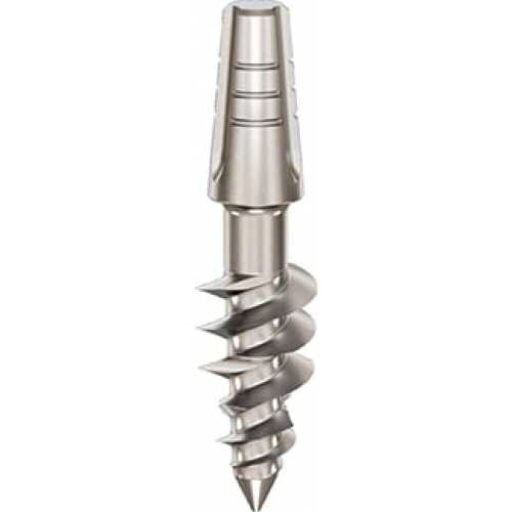
BasalFix is an Italian 🇮🇹 manufacturer of immediate loading basal dental implants. The product range covers four series: Basal, Compressive, Compressive-Fix, and TPI. Each series is engineered for a specific bone condition and jaw zone.
All BasalFix implants are one-piece titanium screws used for the immediate loading of dental crowns and bridges.
Dr Nuri of Nurident is the CEO of BasalFix.
BasalFix Basal
Pure Cortical Anchorage
- Color code: Blue.
- Width range: 2.8 – 4.5 mm
- Length range: 6 – 15 mm
The BasalFix Basal range of implants is designed for zones where the cancellous bone has fully resorbed. It engages the second cortical plate, the hard bone layer on the far side of the jaw, bypassing the soft cancellous layer entirely.
Surface treatment
Plasma treatment by Nobil Bioricerche (Italy). The process removes adherent endotoxin from the titanium surface, validated by lab and clinical studies across millions of implants.
Anchorage mechanism
The implant tip engages the basal cortex of the jaw. In many placements it also contacts a second cortical structure, creating dual cortical fixation that delivers immediate mechanical stability independent of bone quality in the middle layers.
Typical placements and dimensions
The Basal line is usable in all bone types and in both jaws, including in cases of severe bone atrophy. It is also indicated for post-extractive placement.
BasalFix Compressive
Cancellous Bone Compression
- Color code: Green
- Width range: 2.8 – 4.5 mm
- Length range: 6 – 15 mm
The BasalFix Compressive range of implants is designed for zones that retain a layer of healthy cancellous bone. The implant body is slightly oversized relative to the surgical channel, so insertion compresses the surrounding cancellous bone laterally. That compression creates immediate friction-based primary stability. Cortical engagement of the second plate is not required.
Surface treatment
Chemical etching, decontamination, and Argon plasma cold treatment. The result is a homogeneous micro-porosity that increases osteoblast adhesion and accelerates osseointegration. This surface preparation supports the biological healing phase that follows the initial compressive stability.
Anchorage mechanism
Primary stability from lateral compression of cancellous bone at insertion. No second cortex engagement needed. Osseointegration develops through the micro-porous surface over the weeks following surgery.
Typical placements
Compressive implants are used in combination with basal implants in the same jaw. The Compressive line handles zones where cancellous bone is adequate, often found in the frontal part of the jaw.
BasalFix Compressive-Fix
Compression and Cortical Anchorage Combined
- Color code: Green
- Width range: 2.8 – 4.5 mm
- Length range: 6 – 15 mm
The BasalFix Compressive range of implants is a hybrid. The body compresses cancellous bone on insertion, as the Compressive line does. The tip is long enough to also engage the cortical bone, adding mechanical anchorage in the second cortex. Both mechanisms act simultaneously.
Surface treatment
Identical to the Compressive line. Chemical etching, decontamination, and Argon plasma cold treatment produce the same micro-porous surface for osteoblast adhesion and faster osseointegration.
Anchorage mechanism
Dual-source primary stability. Compression of the cancellous bone provides lateral friction. Cortical tip engagement provides deeper axial anchorage. The combination is suited to zones where cancellous bone is present but thinner or less dense than ideal.
Typical placements
The Compressive-Fix is most useful in transition zones, areas where bone quality shifts from moderate cancellous to more atrophied, and where both mechanisms together deliver better primary stability than either would alone.
BasalFix TPI
Tubero-Pterygoid Anchorage
- Color code: Yellow
- Width range: 2.8 – 4.5 mm
- Length range: 6 – 15 mm
The BasalFix TPI (Tubero-Pterygoid Implant) range of implants is a specialist implant for the posterior upper jaw. Its target is the pterygoid process of the sphenoid bone and the tuberosity-pterygoid junction. dense cortical structures at the back of the maxilla that are part of the skull base. This bone does not resorb after tooth loss. The TPI anchors there, bypassing the maxillary sinus entirely. No sinus lift. No bone graft.
Surface treatment
Plasma treatment by Nobil Bioricerche, the same process used for the Basal line. Removes adherent endotoxin from the titanium surface.
Anchorage mechanism
Deep cortical fixation in the pterygoid bone complex. The implant is inserted at a posterior oblique angle. The abutment can be bent up to 15 degrees to compensate for the angulation. Immediate stability comes from cortical engagement in bone that is reliably dense regardless of the degree of maxillary bone loss.
Typical placements and dimensions
The TPI is indicated for the distal maxillary area and premolar zone when adequate bone is present. It can also be used in the lower jaw as a post-extractive implant. Without TPI implants in the posterior maxilla, restoring molar function after severe maxillary bone loss requires a sinus lift, zygomatic implants, or a cantilevered bridge design. The TPI replaces all three with a single oblique cortical fixation behind the sinus.